Foundations
What a social media agency does in England
Learn what a social media agency does in England, how agency teams and service models differ, and how buyers can assess a provider's scope.
What to take away
- Social media agencies in England sell a service that clients can technically run in house. The buying decision rests on evidence of skill, capacity and reporting quality rather than on access to the platforms themselves.
- Scope matters more than the label. Agree in writing whether you are buying community management, paid social, content production or strategy.
- Employment conditions shape what agencies can recruit and charge, which is why day rates and retainer bands move with the wider labour market rather than with follower counts.
- A five-part scoring rubric, covering brief, team, evidence, commercial terms and measurement, gives you a repeatable way to compare shortlisted agencies on the same terms.
Why the foundations matter before you shortlist
The decision in front of most readers is not whether social media matters.
A social media agency manages a client's presence on platforms such as Instagram, LinkedIn, TikTok, Facebook and X. The work usually combines content planning, publishing, community management, paid campaign buying and reporting. Some agencies also produce video, photography and design. Others subcontract all production and focus on strategy and media buying.
Because the label covers so many combinations, two agencies with the same description on a directory listing can offer quite different services. Foundations work means comparing providers against the definition you have chosen.
What counts as a social media agency in England
There is no single legal or regulatory definition of a social media agency. It is a commercial description, not a protected title. That freedom is useful for new entrants and awkward for buyers, because it means quality signals have to be found elsewhere.
Four agency shapes compared
Full-service
- Scope
- Strategy to paid
- Team
- In-house specialists
- Cost base
- Highest
- Best for
- Broad remit
Specialist
- Scope
- One platform
- Team
- Small core plus freelancers
- Cost base
- Variable
- Best for
- Niche needs
Content studio
- Scope
- Production plus publishing
- Team
- Producers and editors
- Cost base
- Production heavy
- Best for
- Content volume
Performance
- Scope
- Paid media led
- Team
- Media buyers
- Cost base
- Media heavy
- Best for
- Ad spend growth
In practice, most England-based agencies fall into a few recognisable shapes. A full-service social agency handles strategy, production, publishing and paid media under one contract. A specialist shop concentrates on one platform or one sector. A content studio sells production with publishing attached. A performance agency leads on paid media and treats organic content as support.
Each shape carries a different cost base. Full-service agencies employ strategists, editors, designers and media buyers. Specialist shops may run with a small core team and a network of freelancers. Understanding which shape you are buying from explains most of the variation in quotes.
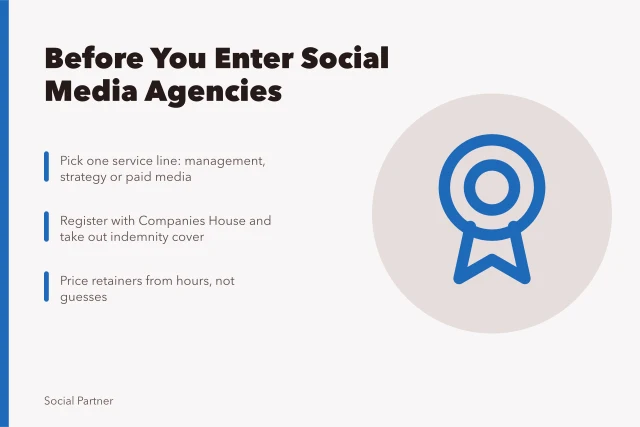
If you are considering setting up rather than buying, the operational steps are set out in our social media agencies market entry checklist, which covers registration, insurance and the first client conversations.
Who buys social media management in England
Demand comes from a wide spread of organisations rather than one dominant sector. Consumer brands, charities, universities, professional services firms, hospitality groups and public bodies all commission social media management. Their reasons differ, and so do their expectations of an agency.
A retailer may want daily publishing and fast response to comments. A university may want campaign support around recruitment cycles. A charity may want community building on a modest budget. A regulated firm may want compliance-aware content that survives internal review.
The common thread is capacity. Most clients can write a post. Fewer can sustain a publishing calendar, respond to comments within an hour and report on results every month without pulling staff off other work. Agencies sell that consistency.
The wider labour market matters here. The Office for National Statistics' Employment in the UK bulletin tracks employment and vacancies. A softer hiring market can make it easier for agencies to recruit, and harder for clients to justify building a large in-house team.
How the market is organised
England's agency market is concentrated in London but not confined to it. Manchester, Birmingham, Leeds, Bristol and Newcastle all support agencies serving regional and national clients. Remote working has widened the catchment further, since a team can serve a client two hundred miles away without a commute.
Trade bodies and professional frameworks give the market some shared vocabulary. IAB UK, which describes itself in its account of the organisation's history as having been formed in 1997 by publishers and media owners, represents much of the digital advertising industry that agencies buy media through.
On the skills side, the Chartered Institute of Marketing maintains a Global Professional Marketing Framework that sets out competencies across marketing disciplines, including digital and social. Clients can use it to describe the capability they expect, and agencies can use it to structure training.
Platform certification adds a second layer of evidence. LinkedIn, Meta and Google all run their own programmes, and LinkedIn publishes details of its Ads certifications for marketers and agencies. Examples include the Meta Certified Media Buying Professional certification and the Google Ads Search certification. A certification is not proof of results, but it is a checkable signal that a named person has completed a defined course.
For a buyer, these bodies are useful as vocabulary and evidence checks, not as quality marks. Directories such as The Drum, Clutch and DesignRush let you filter England agencies by location, sector and service line. Named agencies such as Social Chain in Manchester, Mediaworks in Newcastle and The Social Shepherd in Bath show the regional spread.
The roles inside a social media agency
Job titles vary, but the work usually divides into four groups: strategy, content, community and paid media. Strategy sets objectives and measures. Content plans, writes, films and designs. Community publishes and responds. Paid media builds, buys and optimises campaigns.
A small agency may give one person two or three of these groups. A larger agency separates them and adds account management on top. Neither model is inherently better. What matters is whether the person doing the work has the time and the authority to do it well.
When you brief an agency, ask who will actually run your account day to day. The pitch team and the delivery team are sometimes different people, and the difference shows up in the first month.
Staffing, skills and pay pressure
The cost of a retainer is largely the cost of the people behind it. Salaries, employer National Insurance, pension contributions, holiday cover and software subscriptions all sit inside the fee, along with a margin that funds new business and training.
Skills shortages in specific areas push costs up faster than general inflation. Short-form video editing, paid social buying and analytics tend to command premiums because demand outstrips supply. Generalist content roles are more plentiful and therefore cheaper to fill.
Career expectations are shifting too. The American Marketing Association's 2026 State of Marketing Careers Report examines how AI, skills and job roles are changing marketing work, which is relevant to any client asking whether an agency's team will still look the same in two years.
The practical implication for buyers is simple. If an agency quotes well below the market rate for a scope of work, either the scope is thinner than you think or the team is more junior than you assumed. Both are worth clarifying before signature.
How agencies price social media management
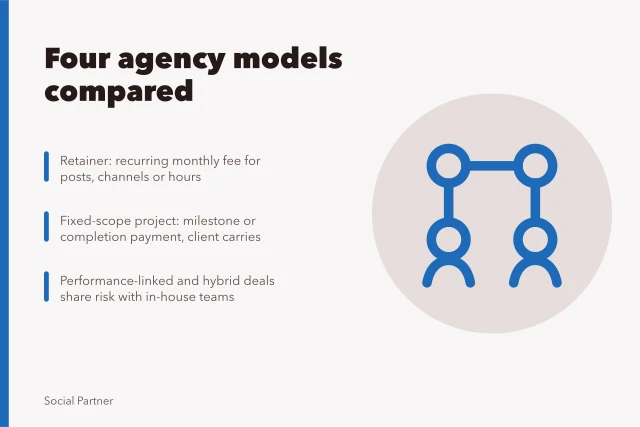
Most England agencies price in one of four ways. A monthly retainer covers an agreed volume of work. A project fee covers a defined piece of work with a start and end. A day rate covers time without a fixed output. A media commission or percentage of ad spend covers buying and optimisation.
Retainer pricing example
Small agency
- Monthly fee
- £1,200
- Posts
- 12
- Community
- Daily
- Reporting
- Monthly
- Team
- Generalist
Larger agency
- Monthly fee
- £4,500
- Posts
- 12
- Community
- Daily
- Reporting
- Monthly
- Team
- Strategist, producer, paid
Retainers are the most common for ongoing social media management. They give the agency predictable income and the client predictable costs. The trade-off is that unused hours rarely roll over, and scope creep is a recurring source of friction.
Contract length and notice are commercial terms, not legal requirements. A typical England norm is a three to six month initial term, followed by a rolling monthly contract with one to three months notice. Shorter trials suit new relationships. Longer terms can secure better rates. Agree the notice period and exit process in writing before signature.
Public agency directories such as The Drum, Clutch and DesignRush publish minimum project sizes and hourly rate bands, which give a benchmark band rather than a single national figure. What determines the fee is scope, team seniority, paid media spend and the number of channels.
Treat those bands as directional only, and compare quotes against the precise deliverables and team assigned.
The detail behind those bands, including how to build a budget line by line, is covered in our social media agencies: costs and budget guide for England. Read it before you set a ceiling for your search.
The five-part scoring rubric
Use the same rubric for every agency you assess, and score each line from one to five. The total gives you a defensible shortlist rather than a gut feeling.
Five-part agency scoring rubric
- Brief fitinsight beyond your brief
- Teamnamed people with relevant work
- Evidencedated results and method
- Commercial termswritten scope and change process
- Measurementagreed framework and review cadence
What to look for
- Brief fit
- Response to your actual objectives, not a generic deck
- Team
- Named people, relevant sector or platform experience
- Evidence
- Case studies, benchmarks and honest reporting samples
- Commercial terms
- Clear scope, notice period and rate card
- Measurement
- Metrics tied to your objectives, reviewed on a schedule
Score 1
- Brief fit
- Repeats your brief back
- Team
- Unnamed juniors
- Evidence
- No examples
- Commercial terms
- Vague inclusions
- Measurement
- Vanity metrics only
Score 5
- Brief fit
- Adds insight you had not considered
- Team
- Named team with evidence of similar work
- Evidence
- Dated results with method explained
- Commercial terms
- Written scope with change process
- Measurement
- Agreed framework and review cadence
A score under fifteen out of twenty five is a warning rather than a rejection. Ask what would change, and see whether the answer is concrete. Agencies that can explain their own gaps tend to manage client expectations better than those that claim none.
Choosing between an agency and an in-house team
In-house teams offer context, speed on internal approvals and direct control. Agencies offer breadth, benchmark data across clients and the ability to scale effort up or down without hiring. Most organisations end up with a blend.
A common split gives strategy and brand voice to internal staff, and production, publishing and paid media to the agency. Another gives the agency everything except crisis response and executive communications. Either can work if the boundaries are written down.
The deciding factor is usually the cost of coordination. Every handover between client and agency consumes time, and a badly drawn boundary costs more than the fee it was meant to save.
Where the commercial opportunities sit
Growth in this market does not come from one source. It comes from clients moving work out of house, from platforms adding formats that require specialist production, and from sectors that previously ignored social media now treating it as a service channel.
Paid social is the most obvious area where budgets move. Organic reach remains unpredictable, so clients increasingly pay to distribute content they have already funded. That shifts agency revenue towards media management and away from pure publishing.
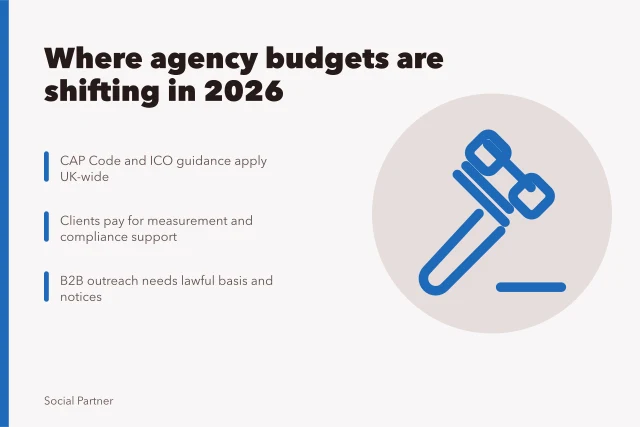
Sector specialisation is the other reliable route. An agency that understands the financial promotions rules set by the Financial Conduct Authority (FCA), or healthcare advertising requirements under the Advertising Standards Authority (ASA) and the CAP Code, can charge more than a generalist because the client saves on compliance risk and internal review time.
Our companion guide on social media agencies commercial opportunities sets out the service lines and sectors where that demand is strongest.
Measuring whether social media management works
Agreement on measurement should happen before the first post is published. If the agency and the client disagree about success in month six, the argument is really about a conversation that never took place.
Useful measures connect to a business outcome. Enquiries, applications, bookings, sign-ups and qualified leads are stronger than impressions. Reach and engagement still matter, but as diagnostic measures that explain why an outcome moved, not as the outcome itself.
Reporting should show what changed, what the agency did, and what it recommends next. A report that only lists totals is a receipt, not a review. Ask to see a sample report before you sign, with client names removed if necessary.
What the supporting guides cover
This page is the pillar of a five-part cluster. Each supporting article takes one foundation and works through it in detail.
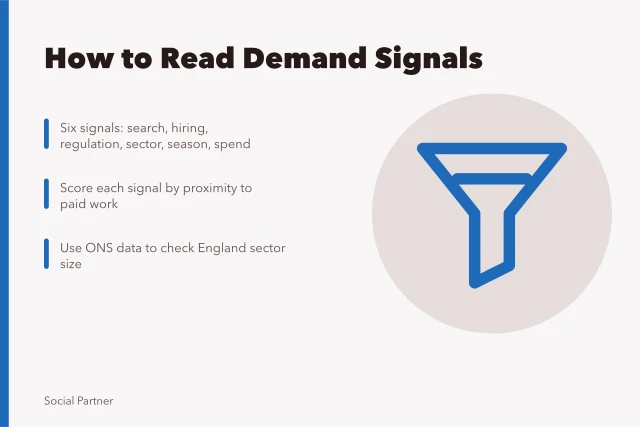
Demand signals are covered in our guide to social media agencies demand signals in England, which looks at how to read sector-level evidence rather than anecdote. Business structures are covered in social media agencies business models in England, which compares retainer, project and performance models.
The remaining two cover entry into the market and the cost of buying from it. Together the five give a buyer or a founder enough grounding to make a first decision without commissioning bespoke research.
Common questions
What is the difference between a social media agency and a digital marketing agency?
A digital marketing agency usually covers search, email, display and social media. A social media agency concentrates on social platforms and the content and community work around them. Some agencies do both and describe themselves either way, so check the service list rather than the label.
Do social media agencies in England need any licence or registration?
No specific licence is required to operate as a social media agency. All limited companies must register with Companies House, and agencies handling personal data must comply with the UK GDPR and the Data Protection Act 2018. The Information Commissioner's Office (ICO) is the UK's data protection regulator. Any claim about regulation beyond that should be checked with the agency directly.
How long should a social media retainer contract run?
Three to six months is a common starting term, with a notice period of one to three months after that. These are market norms, not legal requirements. Shorter trials suit new relationships, while longer terms can secure better rates. Whatever the length, agree the notice period and the exit process in writing.
Can a small business justify an agency retainer?
It depends on the value of the time released and the results achieved. A business paying a lean retainer needs attributable value at least equal to the annual fee before margin. If that figure is unrealistic, a project engagement or a smaller scope is the better route.
In this guide
- What is the market size of social media agencies in England?No official England-only figure exists, but ONS data and industry estimates put the England social media agency market at roughly £700m to £1.4bn in 2024.
- Six demand signals for a social media agencyA practical guide to six demand signals for a social media agency, covering search, hiring, regulation, sector pressure, capacity and referrals.
- Four social media agency business models and what each changes in scope and riskRetainer, fixed-scope project, performance-linked and in-house hybrid agency models explained, with what each means for scope, risk, compliance and exit terms.
- Check these points before starting a social media agencyA pre-launch checklist for starting a social media agency in the UK: company registration, insurance, advertising and data rules, pricing and first clients.
- What changing client demand means for social media agencies' commercial opportunitiesAdvertising rules, B2B data duties and shifting client briefs are reshaping where social media agencies in England find paid work in 2026 and beyond.