Measurement
Part of What social media agencies measurement means for buying and reporting
Nine social media agencies key metrics England teams should track
A guide to the nine social media agencies key metrics England clients should agree, covering reach, engagement, conversion, consent and reporting cadence.
What to take away
- Most teams report follower growth first, and it is the metric least connected to revenue.
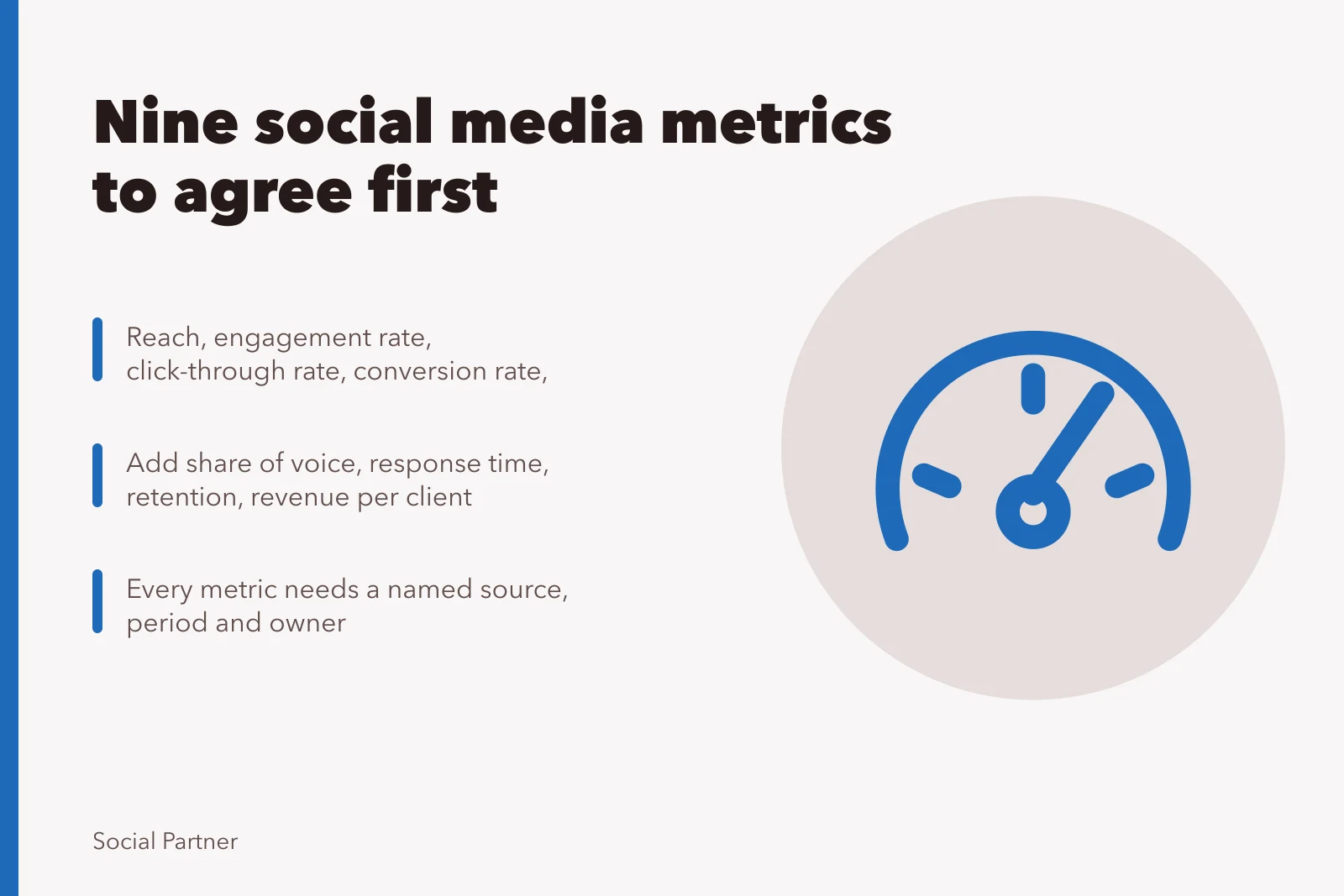
- Agree the set before the first invoicereach, engagement rate, click-through rate, conversion rate and cost per acquisition.
- Add share of voice, response time, retention and revenue per client for the commercial view.
- The nine agencies named below, from We Are Social to Monks, each argue for a different headline number.
- Every metric needs a named source, a period and an owner, or the number drifts between reports.
- Review the set quarterly, because platforms change what they expose and consent rules limit what you can count.
The usual fault is treating follower count as the headline. It is easy to pull and it only moves one way. It tells a client nothing about whether anyone bought. Start from the commercial question, then work back to the numbers that answer it.
Nine social media agencies in England, from We Are Social in London to Social Chain in Manchester, each push a different number to the front of the report. Agreeing the set with one of them takes an afternoon, not a quarter.
Why the metric set matters more than the dashboard
A dashboard is only as good as the definitions behind it. If two analysts count a conversion differently, the monthly trend line is fiction. Write each definition down: which events count, which are excluded, where the data sits.
For how definitions, cadence and evidence fit across a retainer, the measurement and reporting guide sets out the full picture.
Nine agencies and the metrics they track
Each agency below has an English base or office, and each argues for one metric above the rest. Use the right-hand column to write the definition before the first invoice.
| Agency | Metric it argues for first | Definition to write down |
|---|---|---|
| We Are Social, London | Reach | Unique accounts that saw a post. Strong for awareness, weak for sales. Founded in 2008, it co-publishes the annual Digital report with Meltwater, a common source of UK audience figures. |
| Social Chain, Manchester | Engagement rate | Interactions divided by reach. Compare like with like, not across formats. Launched in Manchester in 2014, it was acquired by Brave Bison in 2023. |
| Immediate Future, London | Click-through rate | Clicks divided by impressions. Paid and organic diverge most here. The agency works mainly with B2B technology brands, where the click is the first step you can measure. |
| Impression, Nottingham | Conversion rate | Completed actions divided by sessions. Define the action precisely. It has offices in Nottingham and London and runs paid and organic social side by side. |
| VaynerMedia London | Cost per acquisition | Total spend divided by conversions, including fees rather than media alone. Gary Vaynerchuk's agency runs a London office alongside its New York base. |
| Coolr, London | Share of voice | Your mentions as a share of a competitor set fixed in advance. The London agency has handled grocery and retail accounts. |
| The Social Element, London | Response time | Median minutes to a first reply on a monitored channel. The London agency specialises in social customer care and moderation. |
| The Goat Agency, London | Retention | Share of clients renewing at the end of term. The influencer agency was acquired by Havas in 2022. |
| Monks, London | Revenue per client | Fees plus pass-through costs, divided by active clients. Monks is part of S4 Capital, the London-listed group founded by Sir Martin Sorrell. |
Set the baseline before you promise anything
A benchmark without a baseline is a guess. Pull twelve months of history, note the gaps, and label estimates as estimates. With no history, run a four-week baseline and publish the method alongside the number.
Building a defensible baseline
- Before promisingPull twelve months of history
- During reviewNote the gaps in the data
- When estimatingLabel estimates as estimates
- No historyRun a four-week baseline
- AlwaysPublish the method alongside the number
For sector comparisons, the benchmark research explains how to build a defensible peer set rather than borrowing a figure from a conference slide.
Consent changes what you can count
Social pixels, server-side events and audience matching all involve personal data. The ICO's online tracking guidance is clear that consent must be freely given, specific and recorded, and that withdrawing it must be as easy as giving it.
That affects conversion numbers directly. If consent rates fall, reported conversions fall with them even when sales hold steady. Track consent rate as a metric in its own right, so a client seeing a 20 per cent drop knows whether demand fell or measurement shrank.
Keep creative and paid changes in one record
Paid platforms change targeting, placements and reporting fields regularly. Google Ads publishes those changes through its new features and announcements feed. Log the date of anything touching a reported metric, so a step change in cost per acquisition can be explained rather than argued about.
Creative format matters too. The IAB UK's native distribution principles cover disclosure and labelling, which shape how audiences respond to sponsored placements and therefore what engagement figures mean.
Build the reporting rhythm
Weekly checks on response time catch problems early. The monthly pack covers engagement and conversion, plus click-through where it adds something. Quarterly is the point for cost per acquisition, retention and revenue per client, and for retiring a metric nobody reads.
For example, a team paying £2,500 a month for social media management might report nine metrics weekly and four quarterly, with the rest on request.
Common questions
How many metrics should a client report include?
Nine to twelve suits most retainers. Beyond that, readers disengage and definitions slip. Put the rest in an appendix.
Should organic and paid results be reported together?
Report them separately first, then add a combined view. Blending them hides which channel is doing the work and makes cost per acquisition hard to read.
What if the client cannot access platform data?
Agree read-only access at contract stage. Without it you report from screenshots, which breaks the audit trail and slows every cycle.
How often should the metric set change?
Review quarterly and change deliberately, noting why, so the historical series stays readable.
How do the nine agencies differ?
We Are Social and Social Chain sell brand reach and engagement. The Social Element sells customer care time. The Goat Agency sells influencer work. Monks sells scale. Impression and Immediate Future sell measured response. Match the metric to the brief.