Outlook
Part of How to review social media agencies before renewing a retainer
Six ways social media agencies' AI applications change client work
Six named ways AI applications change social media agency client work, from draft approval and asset licences to comment consent, evidence files and tool budgets.
What to take away
Six changes now shape client work in social media agencies. Each one brings a tool choice and a rule to check.
- AI drafting turns client sign-off into a named approval step.
- Visual generation adds licence checks before assets go live.
- Comment triage becomes a data protection decision.
- Reporting needs source dates, not just platform screenshots.
- Budgets shift from hours to seats, credits and video minutes.
- Procurement asks for disclosure and evidence before renewal.
The CAP Code and PECR still set the baseline. Procurement teams ask who signs off output and what happens when a claim fails.
1. Drafting becomes an approval workflow
Agencies once wrote copy from a blank page. Tools such as Jasper and Copy.ai now draft posts, ad variants and email lines. Jasper sells paid plans per seat and offers brand voice settings. Hootsuite's OwlyWriter AI drafts captions inside its paid social plans.
Draft approval workflow
- Tool drafts post or ad variant
- Record the prompt used
- Save the version
- Name one approver for claims
- Approver signs off before publishing
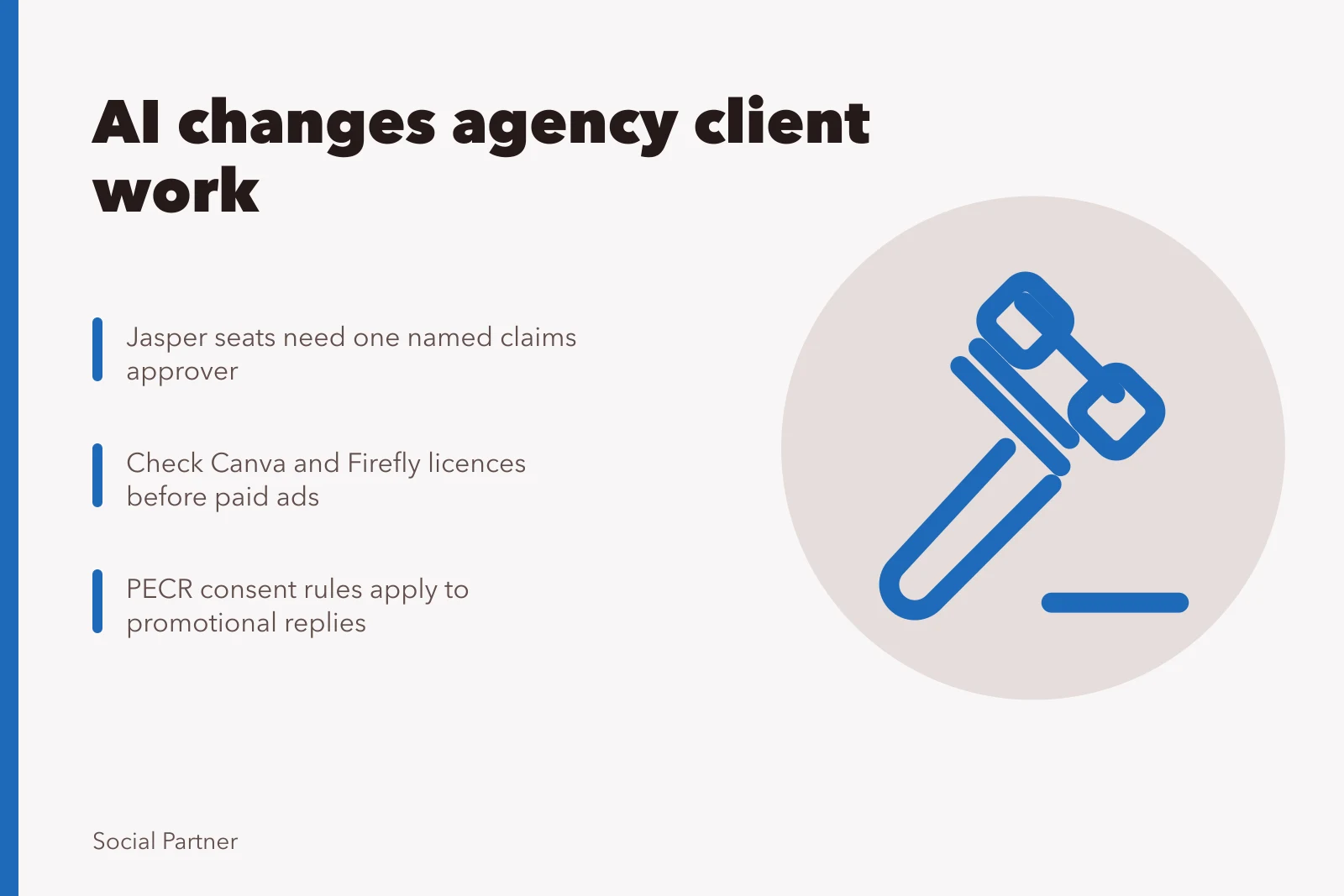
The client change is control. A team paying for three Jasper seats still needs one named approver for claims. Record the prompt, the version and the person who signed off.
The sector view in social media agencies trends and outlook is worth reading before you rebuild a retainer around new tooling.
2. Visual output becomes a licence question
Canva Magic Studio generates images and copy inside Canva Pro, which is billed per user each month. Adobe Firefly sits inside Adobe Express and Photoshop, and Adobe says it is trained on Adobe Stock and licensed content.
Clients now ask which assets can run in paid media. Check the licence terms for each tool before an ad goes live. A generated image can still infringe if it copies a protected style or logo.
3. Comment triage becomes a data task
Sprout Social's AI Assist suggests replies and is available in its paid plans. Brandwatch uses AI for social listening and sentiment analysis, sold as an enterprise subscription.
A public reply can handle a customer question. It becomes electronic marketing when it promotes a product. The Privacy and Electronic Communications Regulations 2003 set consent conditions for electronic marketing.
Write down where that line sits for each channel. Do not let a bot answer a sales question without consent.
4. Reporting becomes an evidence file
Clients no longer accept a platform dashboard alone. They ask which data fed the summary and when it was published. The Office for National Statistics publishes religion statistics from the census, which agencies use as a weighting input.
Treat that data as context, not a targeting rule. Pair each source with its publication date. Add the tool version and prompt history to the client report.
5. Budgets move to seats, credits and minutes
Pricing models change client work. Jasper charges per seat for paid plans. Canva Pro charges per user each month. Synthesia prices by video minutes and offers custom avatars on higher tiers.
A retainer built on hours may not cover tool costs. Put each subscription, credit pack and video minute in the scope. Show the client which line item buys which output.
6. Procurement asks earlier and wants dates
Clients add AI disclosure questions to pitch documents. The ASA resource library holds the guidance behind the CAP Code claims.
Set a review date and a trigger. A platform terms change or a new ASA ruling can pull it forward. If clients plan beyond this year, social media agencies 2027 trends in England sets out changes for the next retainer.
Common questions
Who is responsible for an AI-assisted ad?
Responsibility sits with the advertiser that publishes the claim, not with the tool that drafted it. An agency can write the copy while the brand carries the risk.
Do AI replies to comments need consent?
PECR consent rules bite on electronic marketing, not on answering a customer's question. Write down where that line sits for each channel.
How often should the review run?
Quarterly is a workable baseline, with a trigger-based review when platform terms or guidance change.
What should we tell clients about our tools?
Give categories rather than product names where you can, plus the data each tool touches and the review date. Most clients want to know who controls the output.