Costs and pricing
Part of How to plan a budget for social media agencies costs and pricing
Questions to ask a social media agency before you sign
Five areas where a social media agency can add to the bill — media buying, content, tools, scope and exit — and the questions that cap each one.
What to take away
- Hidden costs at a social media agency cluster in five placesmedia buying, content production, tool access, scope changes and exit work.
- Put the same five questions to every bidderwhat the exclusion list covers, how media spend is charged, who holds the platform and tool subscriptions, who approves extra work, and what the exit fee and notice period are.
- Ask shortlisted agencies for a written exclusion list before comparing headline fees.
- Score transparency and total cost of ownership, not the monthly retainer alone.
- Check supplier numbers with ONS business data to judge whether a quote reflects a crowded market.
1. Media buying and ad spend handling
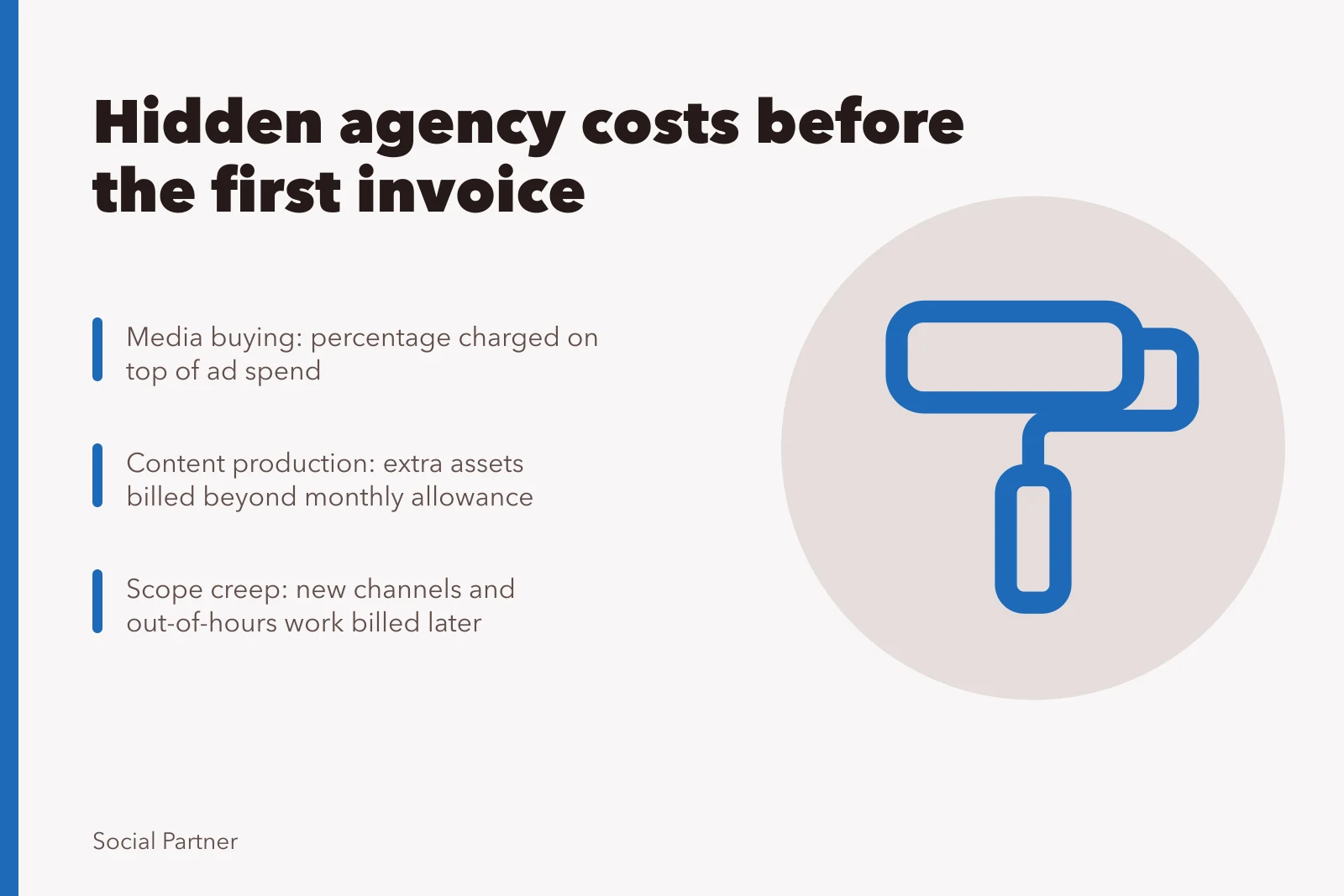
Most retainers cover management, not the money spent on ads. Agencies often charge a percentage of media spend on top of the fee, which rarely appears in the headline quote. For example, a team paying £400 a month in management fees could face a further charge on £10,000 of ad spend.
Media spend charge example
- £400monthly management fee
- £10,000monthly ad spend
- Percentagecharged on media spend
Ask whether the percentage applies to gross or net spend, whether it falls as spend rises and where any tier thresholds sit. Then agree a ceiling and get it in writing.
2. Content production and asset creation
Retainers usually include a set number of posts. Photography, video editing, motion graphics and paid talent sit outside that count, and each extra asset is a line item. If your plan needs original video every week, production can cost more than the management fee.
Content production cost controls
- Set monthly asset allowance
- Agree rate card beyond allowance
- Count photography separately
- Count video editing separately
- Count motion graphics separately
- Count paid talent separately
Set a monthly asset allowance in the contract, then agree a rate card for anything beyond it.
3. Platform, tool and access fees
Scheduling tools, listening platforms, dashboards and stock libraries carry subscription costs. Some agencies absorb these, others pass them through.
The EU's Digital Services Act sets advertising transparency and content moderation duties for online platforms, which can change what agencies must report for brands that advertise across European markets. In the UK, the Online Safety Act 2023 places content duties on platforms, overseen by Ofcom.
4. Scope creep and change requests
Small requests accumulate. A new channel, an extra review round or an out-of-hours crisis response can fall outside the agreed scope. Agencies often absorb the first few to protect the relationship, then bill later.
Agree a change process: name who approves extra work, set a rate for it, and review the log monthly. Our social media agencies costs and budget guide for England lists the budget lines worth planning for.
5. Exit, handover and data transfer
Leaving costs money. Account access transfer, asset archiving, analytics history export and knowledge handover may be chargeable where the contract is silent. Ask for an exit clause that names each handover deliverable, sets a fixed fee for it and gives a notice period.
6. Training and capability building
If your in-house team will run part of the programme, training is often quoted separately. Structured AI literacy training is a common chargeable add-on. The American Marketing Association publishes a marketer's guide to AI literacy and strategy that shows the shape of such a programme.
7. Reporting and measurement add-ons
Basic reporting is usually included. Custom dashboards, attribution modelling, sentiment analysis and quarterly strategy reviews may not be. Our guide to social media agencies return on investment explains how to connect spend to commercial results before you sign.
8. Compliance, legal and accessibility work
Ad disclosure follows the CAP Code enforced by the Advertising Standards Authority, while the Competition and Markets Authority polices undisclosed paid promotion under consumer law. Accessibility work is usually measured against the Web Content Accessibility Guidelines (WCAG), and the Equality Act 2010 covers services offered to the public. Client data handling sits under UK GDPR, overseen by the Information Commissioner's Office. In regulated sectors the agency may need legal review time, so budget for it rather than treating it as overhead.
Scoring rubric for comparing quotes
Score each proposal out of five, weight the criteria to your priorities, then compare totals rather than headline fees.
| Criterion | What to check | Weight |
|---|---|---|
| Fee transparency | Exclusions listed in writing | 20% |
| Media handling | Percentage, thresholds, gross or net | 15% |
| Production rates | Asset allowance and rate card | 15% |
| Tool pass-through | Named subscriptions and costs | 10% |
| Change process | Approval route and rates | 15% |
| Exit terms | Handover deliverables and fee | 15% |
| Reporting scope | What is included at no extra cost | 10% |
How to apply the rubric
Score each proposal, then ask the agency to explain any score below three. The explanation usually reveals more than the number.
What to do with the scores
Shortlist suppliers that score well on transparency and exit terms. Differences between bids usually come from those two rows, not from the quality of the work.
How to check the supplier market
Before you brief, check how many similar firms operate in England. ONS data on UK business activity, size and location covers advertising and market research firms under SIC 73.1. That helps you judge whether a quote reflects a crowded or specialist market.
Common questions
Are hidden costs legal?
Yes, if the contract allows them. The issue is disclosure: ask for a full exclusion list and treat vague answers as a cost signal.
Which hidden cost is usually largest?
Media buying percentages and content production are usually the biggest. Both scale with activity, so they grow faster than the retainer.
Can I cap extra costs?
Often yes. Agree a monthly ceiling for out-of-scope work, with written approval required above it.
Do these costs differ across the UK?
Rates vary by agency location and specialism. The commercial structure is broadly similar, so the rubric applies wherever your supplier is based.