Outlook
How to review social media agencies before renewing a retainer
Review social media agencies before renewing a retainer: assess budget, compliance, team continuity and contract review triggers.
What to take away
- When reviewing social media agencies, decide whether you are renewing or retendering your social media management contract. The 2027 outlook is mainly a budget and compliance question, not a creative one.
- Expect rate cards to keep drifting up while AI absorbs production hours, so ask for task-level pricing rather than a single retainer figure.
- Treat data, advertising and influencer rules as live constraints. They change mid-contract, and your supplier should be tracking them.
- Use the review steps below to compare scope, compliance, team capacity and budget before renewing.
What the 2027 outlook changes in your budget
The practical question for anyone buying social media management is not what is fashionable. It is what you should put in next year's budget and contract. Three forces move at different speeds: platform mechanics, regulation and labour costs.
Three forces, three speeds
Platform mechanics
- Speed of change
- Fastest
- What shifts
- Formats, targeting
- Budget impact
- Paid media
Regulation
- Speed of change
- Slow but hard
- What shifts
- Data, ads, speech
- Budget impact
- Compliance
Labour costs
- Speed of change
- In between
- What shifts
- Wages, skills
- Budget impact
- Senior time
Platform mechanics change fastest, with ad formats, targeting and reporting shifting several times a year. Regulation moves more slowly but changes what you may collect, store and say. Labour costs drift with wages and skills shortages. When you renew a retainer, you buy the supplier's capacity to keep up with all three.
That is why outlook work is a set of questions for a supplier, not a forecast you read once. Start with your own spend split. Paid media management is exposed to platform announcements; content production is exposed to tooling and skills supply.
The compliance backdrop for 2027
Three rule sets touch social media management directly: data protection, advertising standards and platform terms.
Compliance questions for suppliers
- Written position on data handling
- How consent records are kept
- Ad disclosure and labelling process
- Creator briefing on recognition rules
- Documented process, not verbal assurance
Data and direct marketing
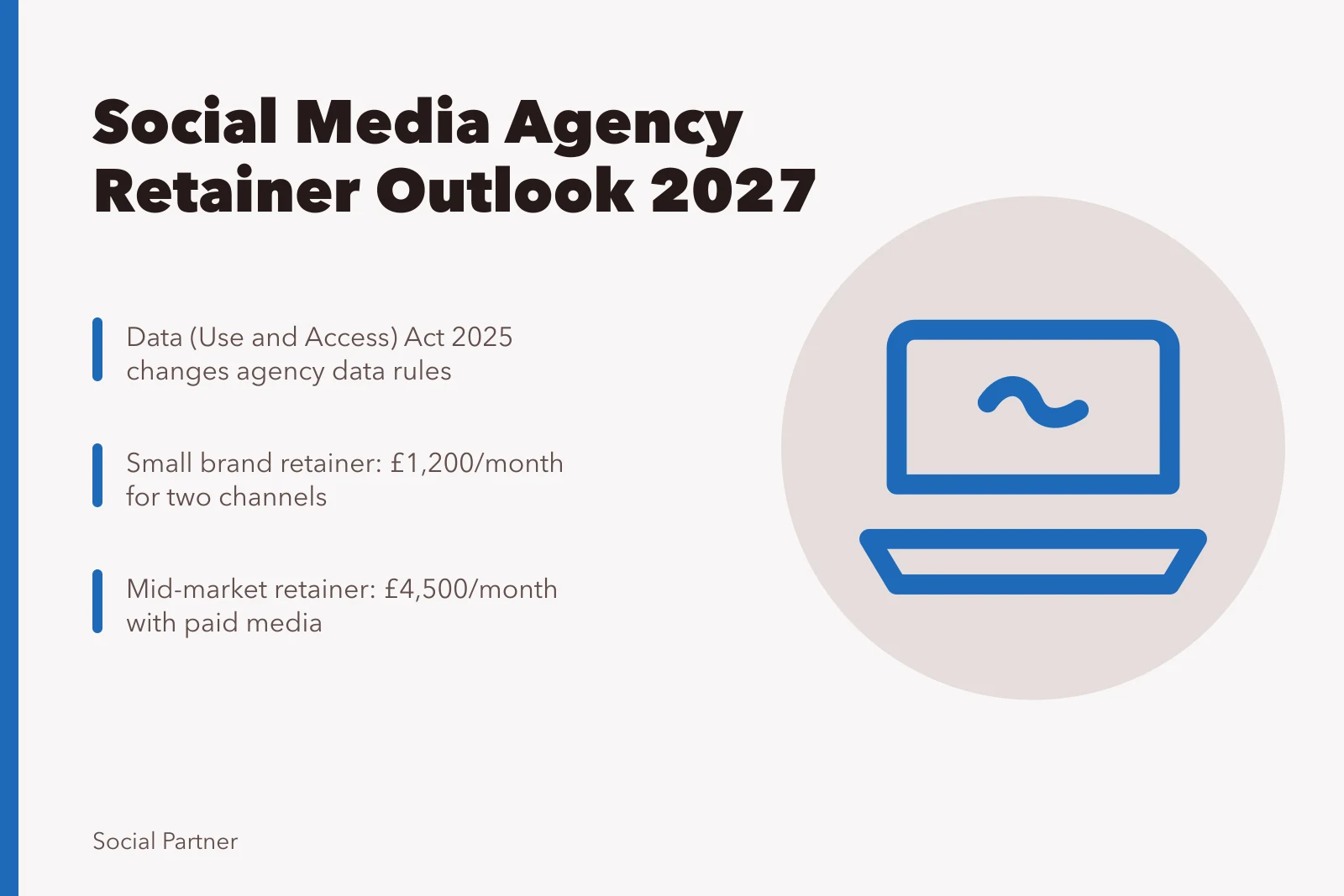
The UK data regime is in motion. The Data (Use and Access) Act 2025 changes parts of the framework that agencies rely on for audience building, consent records and marketing lists.
Under UK GDPR Article 6, you need a lawful basis for processing customer data. Any supplier handling that data should be able to explain how they have adapted.
The Information Commissioner's Office publishes a step-by-step guide to direct marketing for your small business that sets out consent, legitimate interests and suppression in plain terms. Use it to judge whether an agency's process is documented or improvised.
Advertising and influencer rules
Non-broadcast advertising in the UK is governed by the CAP Code, which covers social posts, paid partnerships and influencer content. CAP Code rule 2.1 requires marketing communications to be obviously identifiable as such. A mislabelled post can put the brand, not just the creator, in scope.
Ask your agency how they brief creators on disclosure and who checks the final caption before publication. The answer tells you whether compliance sits with a named person or with hope.
Platform terms also matter: TikTok's Branded Content Policy requires creators to use the branded content toggle, and Meta's advertising standards restrict ads that imply knowledge of personal attributes.
Compliance as a contract deliverable
Put compliance into the contract as a deliverable with an owner. A monthly one-page note covering rule changes that affect your accounts is cheap to provide and easy to audit. Name the platform policies and regulatory clauses that apply, so the supplier has a checklist.
How AI is changing the work, not the price
AI has compressed the time needed for first drafts, variants and basic reporting. It has not removed the need for judgement, brand knowledge or a person who answers when something goes wrong.
That splits the market: routine production is closer to a fixed cost, while strategy and crisis handling remain human. Agencies that only sold production hours are the most exposed, which is a procurement opportunity if you buy carefully.
Use the renewal conversation to agree which tasks AI may support and who remains accountable for reviewing the work.
When you review a proposal, ask which tasks are machine-assisted and how the agency checks output. A price cut with no change in scope usually means junior oversight.
Costs, rates and what to put in the budget
Agency pricing in the UK is usually built from day rates, monthly retainers or project fees. Retainers dominate social media management because the work is continuous.
Public rate cards vary, so use your own scope as the anchor.
As a clearly hypothetical example, a small brand with two channels, a content calendar and community management might budget £1,000 to £2,500 a month.
A mid-market brand with paid media, creator work and reporting might budget £2,500 to £7,000 a month. A multi-market programme can run higher. These are illustrative ranges, not market data.
Build your budget in four lines: strategy and planning, production, paid media management, and measurement. Ask for each separately. Bundled pricing hides where the hours go and makes it hard to compare suppliers.
| Budget line | What to score | Evidence to request |
|---|---|---|
| Strategy and planning | Senior hours, channel plan, measurement framework | Named strategist and monthly hours |
| Production | Output volume, variant testing, asset rights | Task-level rate card and revision limits |
| Paid media management | Platform change handling, targeting and reporting | Account access, change log and fee basis |
| Measurement | Dashboards, attribution limits and insight notes | Data sources, refresh cadence and owner |
Make sure the budget schedule records what each of the four lines includes, so additions can be identified during the contract.
Watch for three cost drivers in 2027. First, senior time, which is scarce and priced accordingly. Second, paid media complexity, as campaign structures and measurement change. Third, compliance work, which is now a real task rather than an afterthought.
A numbered process for reviewing your agency spend
Run this process before you sign anything, not after the first invoice.
Seven-step spend review
- List channels, deliverables and monthly costs
- Mark each line by work type
- Gather written compliance position
- Compare quotes on four-line structure
- Check named people and senior hours
- Set review triggers in contract
- Agree 90-day check-in
- List every channel, deliverable and reporting line in the current contract, with the monthly cost against each.
- Mark each line as production, strategy, paid media or compliance, then note which are now machine-assisted.
- Check the supplier's written answers on data handling, ad disclosure and creator briefing.
- Compare two or three quotes on the same four-line structure, not on headline retainer.
- Check the people who will actually run the account, including senior oversight hours per month.
- Note the platform policies and regulatory clauses that affect your accounts.
- Agree a 90-day check-in where you re-run steps one to three against real invoices.
Step seven is the one most buyers skip, and it is the one that keeps the budget honest.
Signals that should trigger a review
An outlook is only useful if it produces triggers. Set them now so nobody has to argue about it later.
A platform policy change is a trigger. Examples include updates to Meta's advertising standards, TikTok's Branded Content Policy or Google's consent mode for measurement. A regulatory update touching data, advertising or influencer disclosure is another. A shift in your audience mix is a third, and you can usually spot it in your own analytics before any supplier mentions it.
Demographic change matters here. The Office for National Statistics publishes population data by religion and other characteristics that planners use for audience segmentation. A material shift in who you are reaching should reopen the channel plan.
Cost triggers count too. If your retainer rises by more than your own revenue growth, or if hours fall while the fee holds, ask for the task-level breakdown again.
Write the triggers into the contract as review points rather than exit clauses. The aim is a conversation, not a termination.
Scenario planning in practice
Three scenarios are worth holding in mind.
Three planning scenarios
Steady
- Platform rules
- Gradual
- Compliance cost
- Modest
- AI effect
- Trims production
- Main risk
- Complacency
Tightening
- Platform rules
- Arrive together
- Compliance cost
- Larger share
- AI effect
- Trims production
- Main risk
- Bought on price
Expansion
- Platform rules
- Evolve
- Compliance cost
- Stable
- AI effect
- Trims production
- Main risk
- Rising day rates
In a steady scenario, platform rules evolve gradually, compliance costs stay modest and AI keeps trimming production hours. In a tightening scenario, regulation and platform changes arrive together, so compliance and senior oversight take a larger share of the fee.
In an expansion scenario, demand for senior strategists outpaces supply and day rates rise faster than general inflation.
You cannot pick the scenario in advance, but you can test scope, named owners and rates against all three.
Skills and who actually does the work
The skills mix inside agencies is shifting. Media buying, analytics and compliance knowledge are in demand. Basic copy and asset resizing are less scarce than they were.
That changes how you read a pitch. Ask which named people will work on your account, how many hours of senior time are included, and what happens when someone leaves. Agencies that cannot answer are selling capacity they may not have.
Check that the roles your proposal depends on are assigned to named people and that cover is agreed in advance.
Questions to ask about team structure
Who is the day-to-day contact, and who covers their leave? Get both names in the contract schedule.
How is quality checked before publication, and who signs off paid campaigns? A named approver is worth more than a process diagram.
Questions to ask about continuity
What notice do you get if the account lead changes? Thirty days is a reasonable baseline.
How is documentation handed over if the relationship ends? Ask for a named list: content calendar, asset library, ad account access and reporting history.
Paid media and platform change
Paid social is the part of the budget most exposed to platform decisions. Google Ads new features and announcements show how quickly advertising interfaces and measurement options move, and social platforms follow a similar rhythm.
For buyers, paid media management is not a fixed task. It is a subscription to someone else's ability to keep up with formats and targeting changes.
Price it separately from organic content, because the two respond to platform change at different speeds. A monthly note on platform changes that affected your campaigns gives you a defensible record at renewal.
A one-page brief for renewal talks
Summarise your position on a single page before any renewal conversation. Cover the four budget lines, the named team, the compliance deliverable and the scenario you are planning against.
One-page renewal brief
- Four budget lines
- Compliance owner
- Named team
- Review triggers
- Planning scenario
A one-page brief changes the tone of the meeting. Instead of debating creative preferences, you are comparing suppliers against the same structure.
Use current platform and audience changes to pressure-test assumptions about formats and channels before agreeing next year's scope.
Common questions
How much should a UK brand budget for social media management in 2027?
There is no single figure, because scope varies too much. Build the budget from four lines, strategy, production, paid media and measurement, and treat any headline retainer as a starting point rather than an answer.
Does the Data (Use and Access) Act 2025 affect social media marketing?
It changes parts of the UK data framework that marketing teams rely on, including how consent and marketing lists are handled. Ask your agency to show how they have adapted their processes.
Should we move work in-house instead of renewing?
Only if you can cover the senior hours, compliance work and platform monitoring that agencies provide. If not, renewing is usually cheaper than a failed in-house hire.
What is the single best trigger for a contract review?
A platform or regulatory change that affects targeting, measurement or disclosure. It alters the work itself, so it should reopen scope and price rather than sit as a note in a report.
In this guide
- How to assess a social media agency's evidence and skillsA practical social media agency checklist: verify case studies, ad reports and audience claims, then test the people who will deliver your work.
- Six ways social media agencies' AI applications change client workSix named ways AI applications change social media agency client work, from draft approval and asset licences to comment consent, evidence files and tool budgets.
- Planning scenarios for social media agency buyersA practical way for social media agency buyers to review demand, scope, regulation and AI through scenarios, without treating an outlook as a forecast.
- How a social media agency assesses staff skillsA social media agency hiring rubric for assessing staff skills, with weighted criteria, UK data and advertising rules, platform checks and training routes.
- When to rehearse social media agencies risk scenarios before a client crisisA guide to social media agencies risk scenarios in England, covering PECR duties, platform changes, talent gaps and the triggers that force a review.