Outlook
Part of How to review social media agencies before renewing a retainer
Planning scenarios for social media agency buyers
A practical way for social media agency buyers to review demand, scope, regulation and AI through scenarios, without treating an outlook as a forecast.
What to take away
A social media agency market outlook is a forward view of demand, pricing, rules and technology that may shape the work agencies win and the margins they retain.
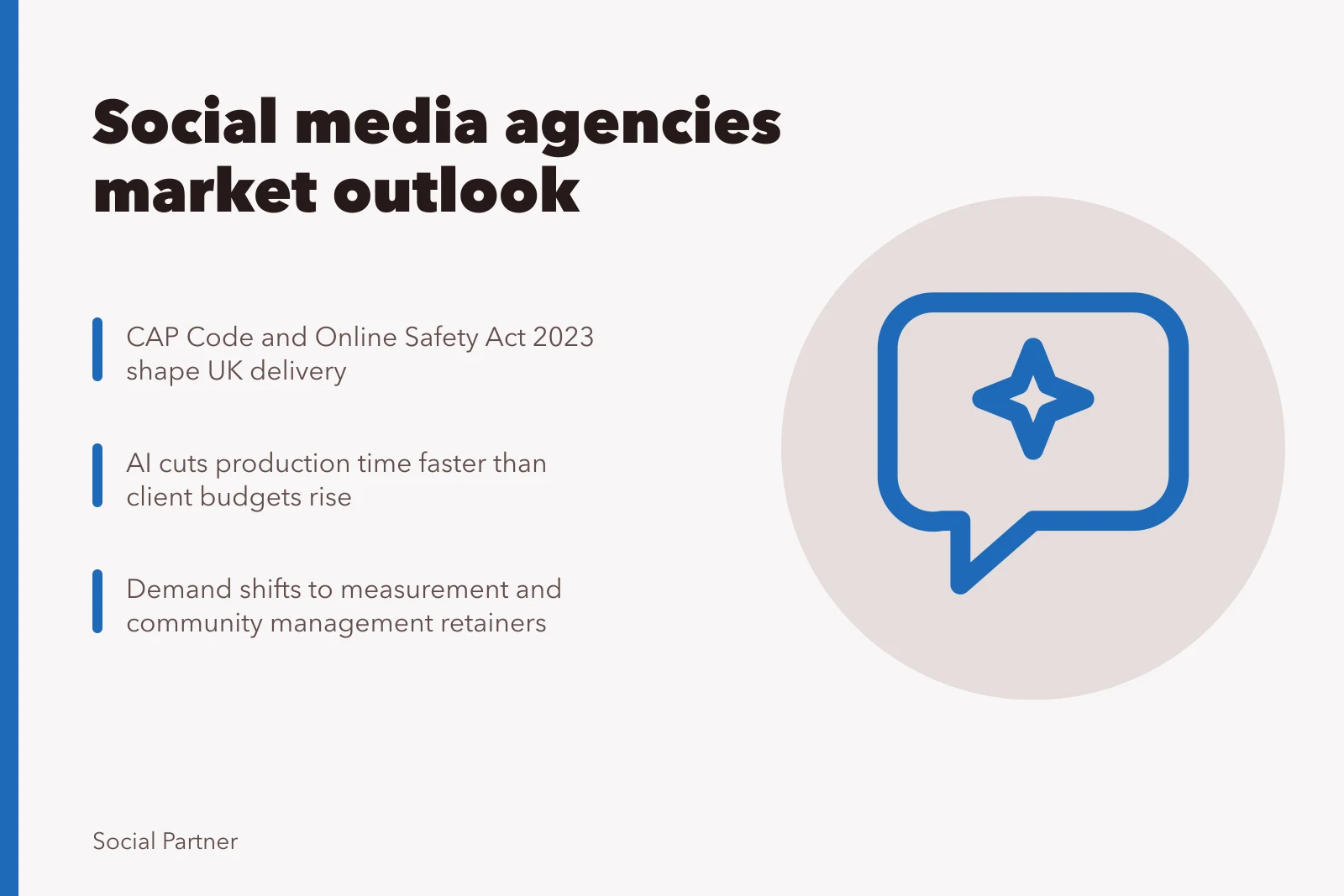
- Treat demand as a question to testare briefs moving towards measurement and community management retainers?
- The CAP Code and Online Safety Act 2023 are relevant to advertising and regulated online services across the UK.
- Ask whether AI is changing production time faster than client budgets, then review scope if it is.
- Fixed review dates beat annual planning, because an outlook ages quickly.
What the outlook actually covers
A market outlook is not one number. It is a set of moving parts to check on a schedule: client demand, rate cards, channel mix, and the rules on what an agency may publish.
A useful outlook says which parts would have to change before you act, and the evidence that would prove it wrong.
Testing demand and pricing assumptions
When assessing UK demand, test whether client briefs are moving towards fewer, longer retainers with tighter reporting duties. Clients want evidence that spend produced enquiries, not impressions.
If briefs place more weight on reporting, agency hours may move from content production into analytics and account management. Treat this as a hypothesis to test against your own client briefs, not as proof of a market-wide shift.
On pricing, the CIM's articles and reports give a grounded view of marketing practice and definitions you can borrow in client conversations. Rates rarely sit alone: day rates, retainer floors and performance elements often share one contract. Ask shortlisted agencies to separate these components and compare scope like for like.
Regulation that can reset your plan
The CAP Code applies to marketing communications within its scope, including relevant social posts. The CAP Code covers misleading claims, ad recognition and sector restrictions, and the Advertising Standards Authority enforces it. Agencies that work with creators should build sign-off around those rules.
The Online Safety Act 2023 places duties on regulated services. Ofcom is the online safety regulator under the Act. For buyers, contracts should make clear who handles comment moderation and reporting, and whether age-assurance work is in scope. Both frameworks apply across the UK, so an agency in Manchester and one in Belfast plan against the same rulebook.
Where AI sits in the outlook
AI may speed agency output on variants, copy and client dashboards, but buyers should test the actual workflow and whether the agreed scope or budget needs changing.
If AI increases output without a matching fee change, margin can be squeezed. Agree how AI-assisted work affects volume, disclosure and sign-off before changing the scope.
Three scenarios for the next planning year
Scenario planning beats a single forecast when a client asks what next year looks like.
Three planning-year scenarios
Steady
- What you see
- Renewals hold
- Response
- Keep scope
- Timing
- At review date
Tightening
- What you see
- Clients cut production
- Response
- Move hours to reporting
- Timing
- Shrink content packages
Disruptive
- What you see
- Platform or AI change
- Response
- Re-price service line
- Timing
- Within a quarter
What you would see
- Steady
- Renewals hold and briefs stay similar
- Tightening
- Clients cut production and ask for measurement only
- Disruptive
- A platform rule or AI tool changes delivery cost
Sensible response
- Steady
- Keep scope, revisit rates at the review date
- Tightening
- Move hours to reporting and shrink content packages
- Disruptive
- Re-price the affected service line within a quarter
As a hypothetical example, a team paying £400 a month for content production might move £150 of that into measurement if the tightening pattern appears. The response column is the part that matters; a scenario you cannot act on is not a scenario.
Update triggers worth diarising
Diarise a review when a client asks for a different reporting cadence, a platform changes its advertising policy, or an automated feature cuts production time. An ASA ruling in your client's sector is another trigger worth logging.
Each trigger is a reason to reread one clause rather than the whole market. Two triggers in the same quarter usually mean the rate card needs work.
Review triggers to diarise
- Client asks for different reporting cadence
- Platform changes its advertising policy
- AI feature cuts production time
- ASA ruling in client's sector
- Two triggers in one quarter
Common questions
How often should an agency review its market outlook?
Every quarter works, with an extra check after any platform policy change. The aim is to catch a shift before it shows up in a renewal conversation.
Is the outlook different in Scotland, Wales or Northern Ireland?
The advertising and online safety frameworks are UK-wide. Client mix and platform use differ by region, which is where local agencies notice variation.
What does the outlook mean for a client with a small budget?
Scope absorbs pressure better than price. A tighter package with clear measurement tends to survive a quiet market.
Do contracts need rewriting each year?
No. Check dates, scope and disclosure terms when a major rule or platform change lands.