Audience research
Part of When to run audience research for social media agencies
Building a social media agencies customer interviews programme explained
Six steps for running social media agencies customer interviews in England: consent under PECR, recruitment, question design, incentives and coding.
What to take away
- Customer interviews capture the language buyers use before they brief an agency, which no directory listing supplies.
- Write your purpose, lawful basis and consent line before the first call, because recruiting interviewees counts as direct marketing.
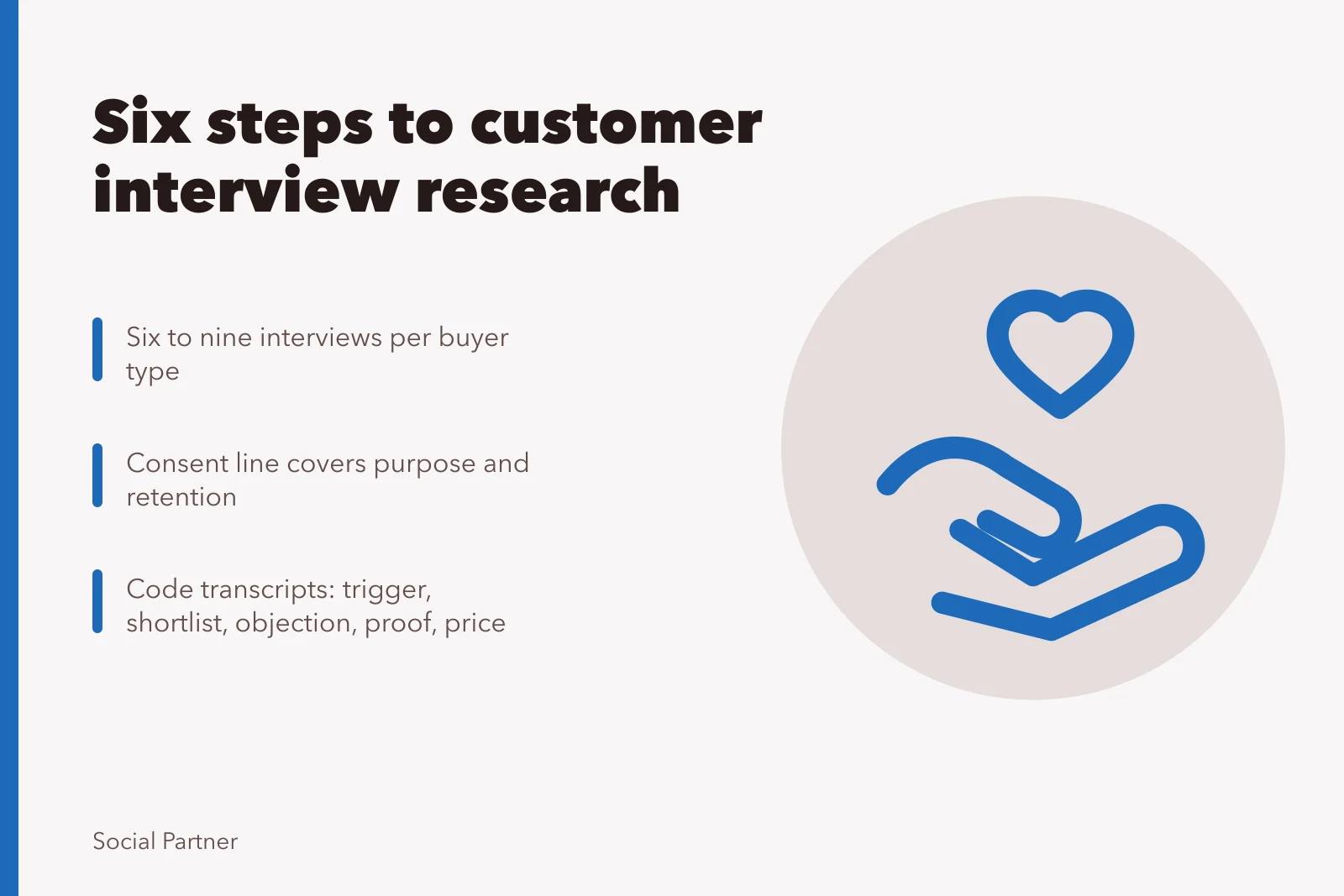
- Six to nine interviews per buyer type surfaces the repeated themes; stop when two calls in a row say nothing new.
- Record only with consent, keep transcripts out of your CRM, and delete them on the date you promised.
- The output should be a short brief for your social media management team, not a deck nobody opens.
Set the scope before you recruit
Write your inclusion criteria
Inclusion criteria keep the sample honest. Decide the buyer type, deal size, sector and time window, then commit them to paper before approaching anyone.
Inclusion criteria to write down
- Buyer typerole with budget authority
- Deal sizethe range you sell
- Sectorwhich industries qualify
- Time windowwhen they bought
- CoverageEngland only, not UK
Where the research covers England only, say so on the recruitment note rather than implying UK coverage. The wider audience research guide for England sets out how the same method fits a full research programme.
Choose the buyer type you actually sell to
Interview the person who signs the contract, not the person who admires your posts. In smaller firms that is often the owner. In larger ones it may be a marketing lead who still needs finance approval. Mixing the two in one sample produces muddled findings, so run separate rounds if you sell to both.
Run the interviews lawfully and consistently
Consent, purpose and the ICO rules
Recruiting interviewees by email or phone is direct marketing even when nothing is being sold. The ICO's direct marketing and PECR guidance therefore governs how you make contact and what you record. State the purpose, the retention period and how to withdraw. Keep the consent line in the same document as your notes.
Recruit and incentivise without skewing answers
Offer a modest thank-you rather than a large one. For example, a team offering a £25 voucher to a sole trader is likelier to get honest answers than one offering £250, which starts to feel like a sale. Ask for 30 minutes, send questions in advance, and never reveal who else you have spoken to.
Ask about past behaviour, not opinions
Ask what happened last time they chose or left an agency, what they compared, and who else was in the room. Avoid asking whether they would use a service, because most people say yes. Where social video comes up, the official YouTube advertising information is a neutral reference for how those formats are bought.
Turn transcripts into a brief
Code the transcripts
Tag each transcript with plain labels: trigger, shortlist, objection, proof, price, and count how many interviewees mention each.
A theme in seven of nine calls is worth acting on; one appearance is an anecdote. When rivals come up, our competitor research for social media agencies shows how to turn comparisons into a positioning decision, not a public claim.
Feed findings into the brief and the creative
Give your social media management team the three strongest themes, the quotes behind them and the objections that killed deals. If you make native or sponsored posts from those themes, the IAB UK's native distribution principles for creative best practice cover paid distribution and disclosure.
Small glossary
- Buyer type
- the role you interview, defined by budget authority.
- Inclusion criteria
- the written rules deciding who qualifies.
- Coding
- labelling transcript passages so themes can be counted.
- Saturation
- the point where new calls repeat existing themes.
- Retention period
- the date by which recordings and notes are deleted.
Common questions
How many interviews do I need?
Six to nine per buyer type usually surfaces the main themes. Stop when two consecutive calls add nothing new. If your buyers split into two very different groups, treat them as two samples.
Do I need consent to record a call?
Yes. Ask before recording and note the answer. The ICO's direct marketing rules also require a lawful basis for holding contact details, and you should say how long the recording is kept.
Can I use quotes in marketing?
Only with specific permission for that use. Consent to be interviewed is not consent to be quoted in a case study, so ask separately and keep the reply on file.
What if interviewees describe a rival agency?
Code it neutrally as a comparison point. Do not repeat claims about named competitors in your own marketing.