Audience research
Part of When to run audience research for social media agencies
Running social media agencies competitor research without paid tools
A social media agency checklist for free competitor research, with named ad libraries, Google Trends and UK rules on advertising and electronic marketing.
What to take away
- A Bristol social media management team can run competitor research with a spreadsheet, public ad libraries and free trend data, without a subscription.
- Use our linked audience research guide for England to define who you serve before interpreting competitor findings.
- The rules that govern how you gather material come from the Advertising Standards Authority (ASA) and the Committee of Advertising Practice (CAP), not from the tools you choose.
- Cookie and tracking checks should follow the Information Commissioner's Office (ICO) guide to the Privacy and Electronic Communications Regulations 2003 (PECR), which applies across the UK.
- Set a fixed research window, usually two to four weeks, so every snapshot stays comparable.
Why do social media agencies competitor research in England?
Competitor research answers a narrow question: what are other agencies in your patch publishing, and to whom? For a social media agency in Leeds or Norwich, the answer shapes your pitch, your pricing and your content calendar.
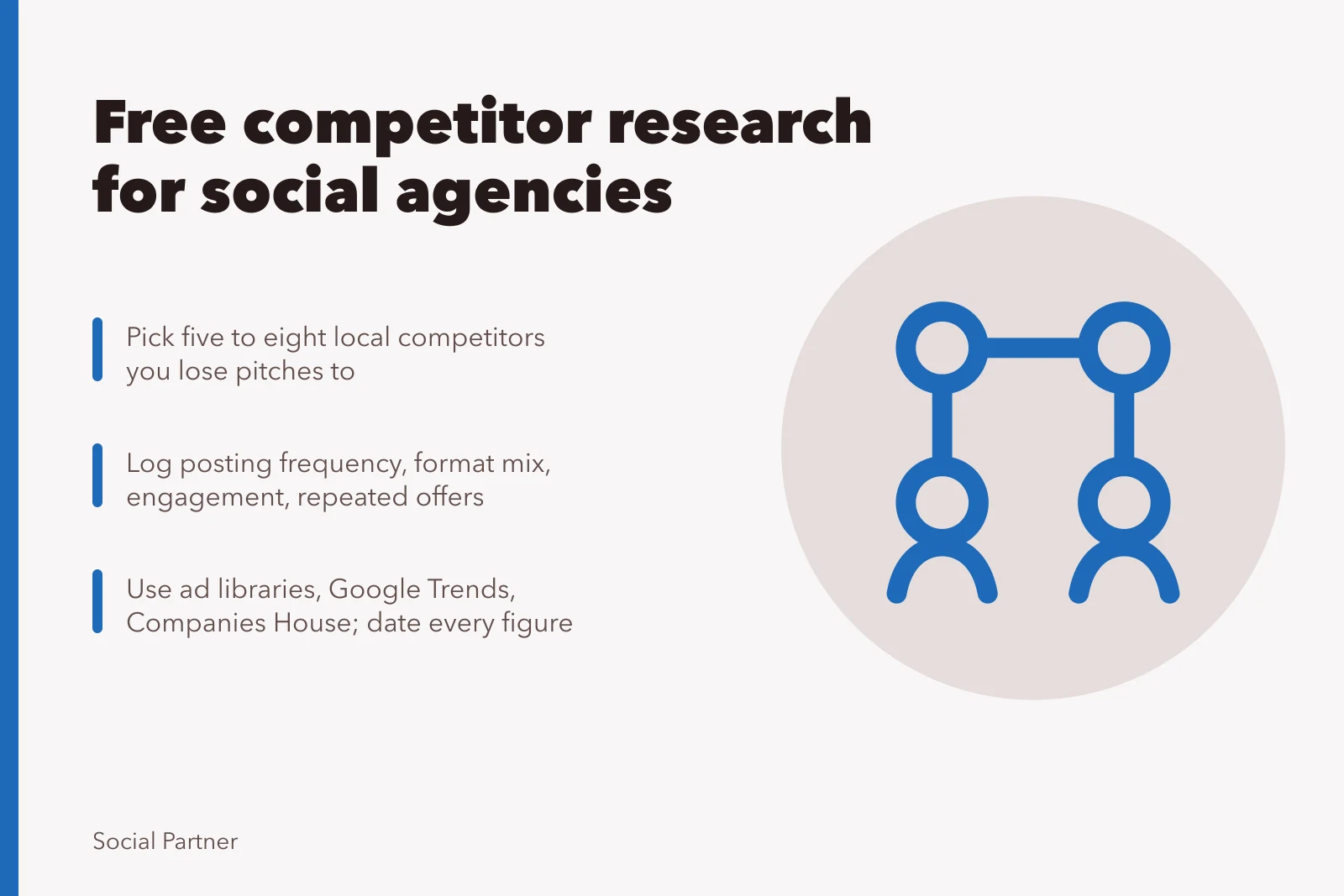
Most pitches are won or lost locally, so weight nearby agencies above national names. Keep the scope small. Pick five to eight competitors you genuinely lose pitches to, not the loudest accounts nationally.
What should you record for each competitor?
Competitor data columns
- Posting frequency
- Format mix
- Average engagement per post
- Repeated offers
- Audience signals
- Date logged
Note the audience signals they use, such as local landmarks, regional spelling or sector jargon.
Compare those signals with your own audience definition and the target audience in England notes, rather than treating a competitor's assumptions as facts. Gaps can suggest a positioning angle to test.
Log every figure with a date. A post count from March is not the same as one from August.
Which free sources give usable data?
These sources are free to use. They show public advertising or search-interest signals, not a competitor's complete results:
- Meta Ad Library:search public ads across Meta platforms, including Facebook and Instagram, to review advertisers' creative and messaging.
- TikTok Creative Center:use its Top Ads and trend resources to spot creative formats and topics to investigate.
- LinkedIn Ad Library:review public ads on LinkedIn and compare their messaging and creative.
- Google Ads Transparency Center:look up advertisers and review their ads shown on Google services.
- Google Trends:explore search-interest patterns for competitor names or sector topics over time and by location. It does not show a competitor's actual traffic or results.
Free data sources
Source
- Platform ad libraries
- Live paid creative
- Public follower counts
- Audience size on fixed dates
- Google Trends
- Regional search interest
- Companies House
- Turnover signals
What it gives
- Platform ad libraries
- Public follower counts
- Google Trends
- Companies House
Capture screenshots with dates, because ad libraries retire creative without notice.
LinkedIn's ad resources for marketing agencies explain how B2B campaigns are structured, which helps you interpret an ad library rather than guess.
Where research involves sending electronic marketing, follow the Privacy and Electronic Communications Regulations 2003 (PECR) and the ICO's guide to PECR. PECR's requirements depend on the recipient and circumstances, so collecting a public email address is not, by itself, permission to market to that person.
How do you keep the research lawful?
Do not scrape personal data from public profiles. Do not screenshot private groups or join a competitor's newsletter under a false name to see their funnel.
Under Section 3 of the CAP Code, rule 3.1 says marketing communications must not materially mislead or be likely to do so. Rule 3.7 requires marketers to hold documentary evidence for objective claims before publication. When reviewing rivals, note claims that appear unsupported, and check your own evidence before making comparable claims.
Keep notes in one place, limited to the people who need them. Delete raw contact data once the analysis is finished.
Worked example with labelled figures
An illustrative example: a three-person social media management studio in Reading spends eight hours a month on competitor research. At a labelled internal cost of £35 an hour, that is £280 a month, or £3,360 a year.
It tracks six competitors across four channels. Two publish roughly 20 posts a month each, and the rest publish fewer than eight. Only one posts video more than twice a week, so the studio tests three short videos a week for a quarter.
Two rivals claim "fastest response times in Berkshire" with no published evidence. The studio records the claim, avoids repeating it, and writes its own pledge with a measured response window instead.
How often should you repeat the research?
Run a full sweep twice a year and a light check quarterly. A light check means follower counts, posting cadence and any new paid creative.
Keep the same columns each time so periods compare. If a competitor changes format, note the date and check whether engagement moved with it.
Review the findings with whoever writes your pitches. Research that never reaches the pitch is a cost, not an asset.
Common questions
Do I need paid tools for competitor research?
No. Meta Ad Library, TikTok Creative Center, LinkedIn Ad Library and Google Ads Transparency Center let you review public ads; Google Trends provides search-interest context. These sources do not reveal competitors' complete performance data. Paid tools mainly save time on collection, not on interpretation.
Is it lawful to monitor competitor social accounts?
Yes, when you use publicly visible posts and avoid personal data. Scraping profiles or harvesting contact details without a lawful basis breaches data protection rules.
How many competitors should a small agency track?
Five to eight is workable for one person. Beyond that, the recording becomes the job rather than the insight.
What is the single most useful metric to record?
Posting cadence by format. It is quick to count, easy to compare across periods, and it reveals where a competitor is investing effort.