Reviews
Part of How to judge social media agencies reviews and verify claims before shortlisting
What we check before you brief a social media agency
How we review a social media agency: the evidence we check, what we do not test, and how vendor claims are checked against independent records.
What to take away
A review methodology is the fixed set of checks, evidence rules and scoring weights applied to every social media agency before a verdict is published.
- We assess published evidencecompany registration and filings, platform documentation, regulator rulings and the agency's own case material.
- We do not run hands-on tests, commission audits or interview agency staff, so nothing here is presented as tested performance.
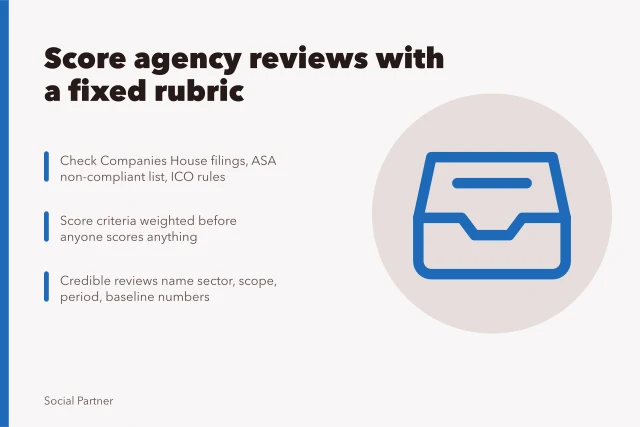
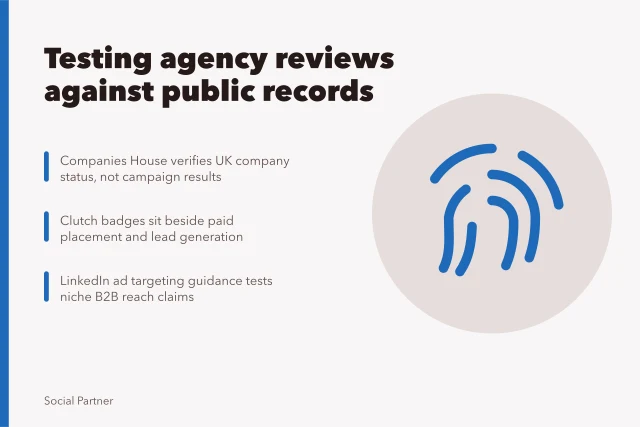
- Vendor claims are labelled as claims and scored separately from independent sources such as Companies House records or an ASA non-compliance listing.
- Scores are weighted, dated and versioned, so a review can be rechecked rather than treated as a permanent ranking.
- Fit matters more than a headline scorebudget band, sector and channel mix change which agency suits you.
Why a fixed method beats a star rating
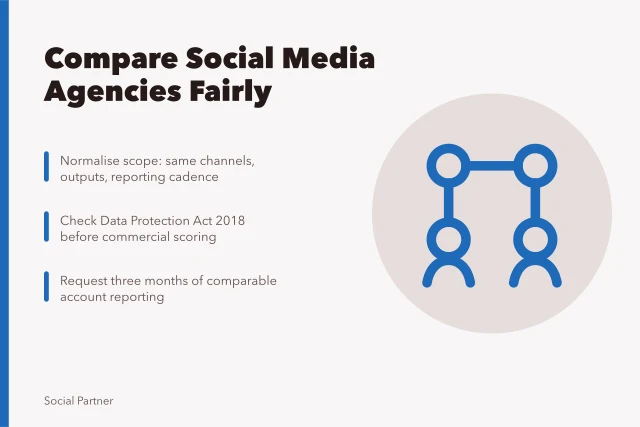
A single star rating hides the basis for the judgement. Our method publishes the criteria, the evidence type behind each one, and the date the check ran.
That lets a buyer dispute a weighting and still use the underlying facts. It keeps comparisons honest when agencies publish different figures about themselves. For the wider approach, see social media agencies reviews and comparison methods, which shows how the evidence categories fit together.
What sits outside the method
We do not verify client results, staff credentials or pitch behaviour. We do not score cultural fit, chemistry or how quickly an agency answers a speculative email. Those require your own meetings and references. Treat any review as a screening tool that shortens your longlist, not as a substitute for a procurement process.
The criteria we score
Every agency is put through the same categories in the same order. Each entry records the evidence type behind it and the date the check ran, so you can see what was looked at, and when.
Registration, filings and ownership
Every agency is checked against the register before anything else. We look at incorporation date, filing history, accounts status and any change of name or ownership. A dormant filing or overdue accounts is a risk flag, not an automatic rejection. You can repeat this check yourself using the Companies House register of UK companies before you release a brief.
Agency checks before briefing
- Companies Houseincorporation, filings, accounts
- Claimsplatforms named and reporting described
- Measurement definition behind reach claims
- ONS population data for audience sizing
- ASA non-compliant advertiser list check
Claims, channels and measurement
We record what the agency says it does, which platforms it names and how it describes reporting; claims are scored as claims. If an agency promises reach or engagement growth, we look for the measurement definition behind it.
Population data helps sanity check audience sizing claims, and the Office for National Statistics population estimates give a defensible base.
Compliance and advertising conduct
We check whether the agency appears on the ASA list of non-compliant online advertisers. A listing is a serious flag: it reflects a regulator's view, not a competitor's.
Absence from the list is not a clean bill of health: it covers only named advertisers at a point in time. We still check the agency's ad examples for disclosure and substantiation.
Comparison at a glance
Source
- Company registration and filings
- Companies House
- Regulator enforcement
- ASA non-compliant list
- Audience base data
- ONS population estimates
- Agency case studies
- Agency website
- Client references
- Not collected
- Hands-on testing
- Not performed
- Pitch experience
- Not observed
Scored?
- Company registration and filings
- Yes
- Regulator enforcement
- Yes
- Audience base data
- Yes, as context
- Agency case studies
- Yes, as claims
- Client references
- No
- Hands-on testing
- No
- Pitch experience
- No
Weighting, versioning and shortlisting
Two things decide how a review is read: how the criteria are weighted for your situation, and how current the checks behind it are.
Weighting and versioning
Weights differ by buyer type: a regulated advertiser weights compliance evidence more heavily, while a small team may weight cost transparency. Each review shows its weighting version and the date checks were run. If an agency files new accounts, the review can be revised without rewriting the whole piece.
From review to shortlist
- Cut list using scored evidence
- Set a paid discovery task
- Take two references
- Agree a written scope
- Review again 90 days after appointment
For a side-by-side view of agency service packaging, read social media agencies product comparison before weighting the criteria yourself.
Turning a review into a shortlist
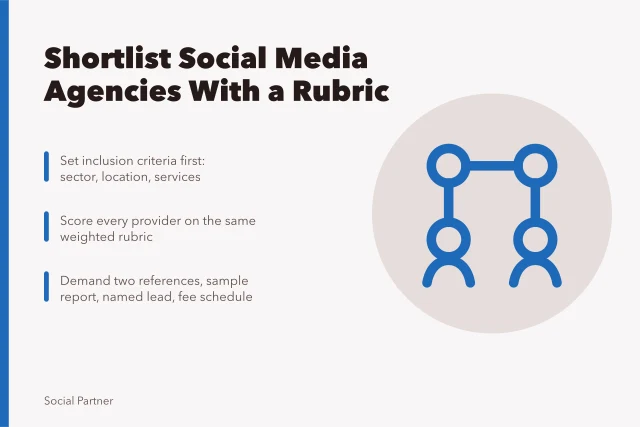
Use the scored evidence to cut the list, then apply your own tests: a paid discovery task, two references and a written scope. Set a review date 90 days after appointment so the evidence is refreshed against delivery. Keep a note of what you checked and when, because that record is what protects you if performance drifts.
Common questions
Is this a hands-on review?
No. The method assesses published evidence and vendor claims only. We do not test campaigns, access client accounts or interview agency staff, so no performance figure here comes from our own testing.
How are vendor claims treated?
They are logged, quoted and scored as claims, then marked against independent sources where one exists. A claim with no supporting evidence lowers the confidence score rather than the agency's compliance score.
How often are reviews updated?
Each review carries the date its checks ran and a weighting version. We refresh when a material filing, ruling or service change appears, or at the next scheduled review date.
Can a low score be appealed?
Yes, by submitting evidence we missed. Corrections are published with the date and the source, and the original score is retained in the version history so buyers can see what changed.