Costs and pricing
Part of How to plan a budget for social media agencies costs and pricing
Eight lines every social media agencies budget template needs
Build a social media agencies budget template that survives finance scrutiny: eight numbered cost lines, review dates and the evidence each figure needs in England.
What to take away
- Most budget templates fail because they list agency fees and forget the internal cost of managing the agency, which is usually the larger number over a year.
- Eight cost lines cover the recurring workplatform tools, content production, media spend, agency retainer, project fees, training, compliance time and contingency.
- Every line needs a named owner, a review date and a source for the number, or finance will treat the whole sheet as guesswork.
- Monthly smoothing hides seasonal spikes, so build the template around quarters and flag the months where spend doubles.
- Treat the template as a rolling document with fixed review points, not a one-off spreadsheet signed in January.
Why the first draft usually misses half the cost
Teams start with the retainer figure because it is the easiest number to find. The retainer is rarely the biggest line. Internal time spent briefing, approving and reporting on agency work sits in salaries that never appear on the sheet.
A workable template separates money leaving the business from time already paid for. Both belong in the same document, even when only one is a cash cost. See the wider cost picture in our social media agencies costs and budget guide for England before you fix line values.
The eight lines to build into the template
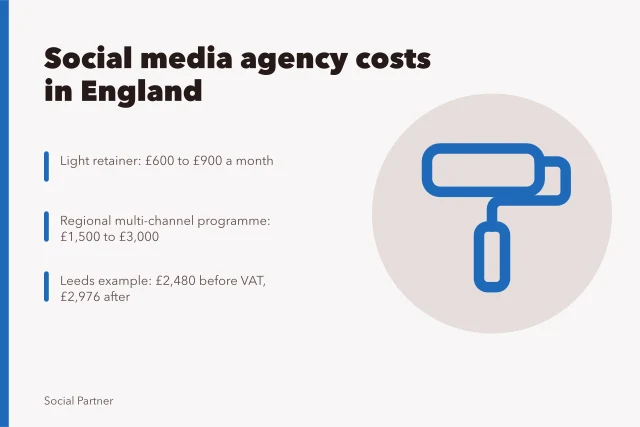
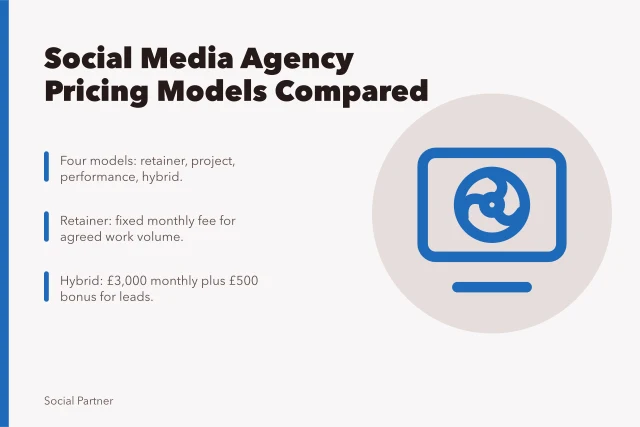
- Agency retainer or monthly fee. Record the contracted figure, the notice period and whether it rises at renewal. For example, a team paying £3,500 a month should show £42,000 a year, labelled as an illustrative example.
- Platform tools and scheduling software. Seat-based licences change as headcount moves, so review quarterly.
- Content production. Photography, video editing and copywriting often sit outside the retainer and arrive as separate invoices.
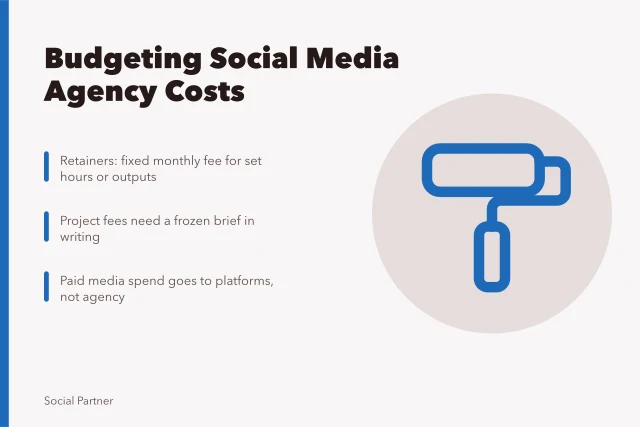
- Paid media spend. Keep this separate from fees so you can pause spend without renegotiating the contract.
- Project fees. Campaigns, launches and one-off research sit here rather than in the retainer line.
- Training and accreditation. Budget for platform certification and marketing qualifications; the Global Professional Marketing Framework from CIM sets out the competencies worth funding.
- Compliance and data time. Legal review, records requests and AI tool checks consume staff hours that need a line of their own; the ICO publishes guidance on artificial intelligence that shapes how social data can be used.
- Contingency. Hold five to ten per cent of the annual total for platform price changes and scope creep.
Give every line an owner and a review date
A template without owners becomes a wish list. Put a name against each line and a date when the number is checked. Quarterly works for most teams; monthly suits anyone running always-on paid media.
Review frequency by activity
Quarterly
- Best for
- Most teams
- Owner
- Named person
- Check
- Each line value
Monthly
- Best for
- Always-on paid media
- Owner
- Named person
- Check
- Spend and fees
Industry context helps you judge whether a quoted rate is plausible. The IAB UK background on the digital advertising industry body explains the sector the agency buys within, which is useful when a media plan looks unusually cheap or expensive.
Link the template to return on investment
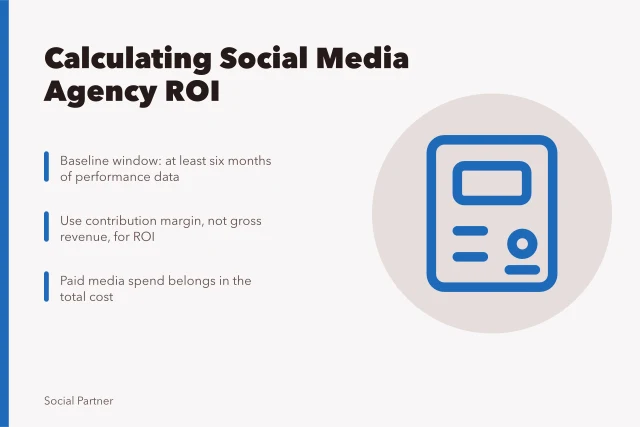
Cost lines only make sense next to outcomes. Add a second tab that tracks reach, enquiries and revenue against each quarter, then compare it with the social media agencies return on investment measures your finance team already accepts.
If the template shows rising fees and flat returns for two quarters, that is the trigger for a contract conversation rather than another year of the same arrangement.
Budget for the awkward months
Social spend is not evenly spread. Retail peaks before December, recruitment peaks in January, and both distort an annual average. Mark the heavy months in the template and show the cash impact separately, so the finance team is not surprised in November.
Set a threshold, for example any month above £8,000 of combined fees and media, labelled as an illustrative example, that needs sign-off before the agency commits spend.
Common questions
How many cost lines should a template have?
Eight recurring lines cover most arrangements, plus a contingency. Add project lines only when a campaign is approved, and close them when it ends.
Should the agency retainer and media spend sit together?
Keep them apart. Media spend should be pausable and auditable on its own, while the retainer covers people and planning.
How often should the template be reviewed?
Quarterly as a minimum, with a full rebuild before each contract renewal. Monthly reviews suit teams with continuous paid activity.
What evidence should sit behind each figure?
An invoice, a signed contract or a dated quote. Anything else should be labelled as an estimate until it is confirmed.