Costs and pricing
How to plan a budget for social media agencies costs and pricing
A guide to social media agencies costs and pricing in England, covering retainer fees, project work, paid media budgets and the checks to run before signing.
What to take away
Social media agencies costs and pricing means the fees an agency charges for planning, content, community management and reporting, plus any advertising budget you fund separately.
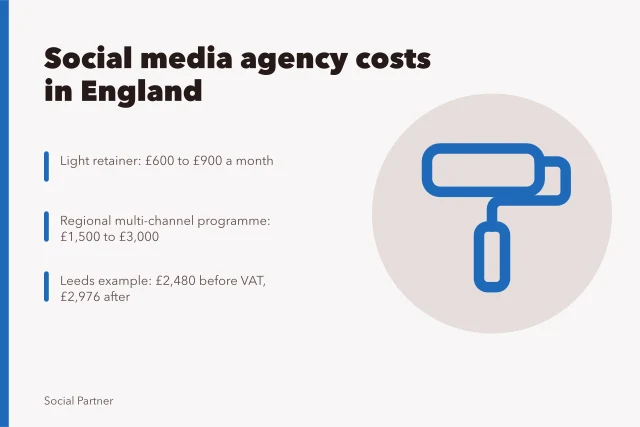
- Typical England market rates run from about £900 to £3,500 a month for a retainer, £1,500 to £12,000 for a fixed project and £350 to £900 for a day rate.
- Agencies across England usually price work as a monthly retainer, a fixed project fee or a day rate, and the model shapes the total more than the headline figure.
- Fees pay for people and process, while paid media spend goes to the platforms and normally carries a management charge on top.
- Insist on a written scope naming deliverables, revision rounds, response times and what triggers an extra charge.
- Hold back a contingency, because video, influencer work and additional ad accounts rarely appear in the first quote.
- Check the agency's registration and filed accounts, and ask how it handles personal data.
What a quote actually covers
A quote from an agency mixes three kinds of cost. The first is labour: strategy, copywriting and community management. Then come pass-through items such as scheduling tools and analytics seats. Media spend is the third, and it goes to the platforms rather than to the agency.
What a quote covers
Labour
- Who gets paid
- Agency
- Typical items
- Strategy, copy, community
- VAT
- Usually excluded
- Benchmarking
- Compare hours
Pass-through
- Who gets paid
- Suppliers
- Typical items
- Tools, analytics seats
- VAT
- Usually excluded
- Benchmarking
- Compare tools
Media spend
- Who gets paid
- Platforms
- Typical items
- Ad spend
- VAT
- Usually excluded
- Benchmarking
- Compare reach
Separating those lines early makes every later comparison cleaner. Ask each agency to show them apart, even when the final invoice arrives as one figure. A quote with media spend buried inside a single monthly number is hard to benchmark.
Check whether the figure includes VAT. Most agencies quote excluding VAT, and the difference matters on a twelve-month contract. VAT on agency fees for England-based buyers is normally charged at the standard 20% rate when the agency is VAT registered, and only VAT-registered buyers can reclaim it.
Our social media agencies cost guide in England lists the ranges buyers report for each line, which gives you something specific to compare a proposal against.
How monthly retainers are priced
A retainer is the default arrangement for ongoing social media management. You pay a fixed monthly fee, and the agency reserves either a set number of hours or a defined set of outputs.
Retainer scope drives price
Light scope
- Channels
- One
- Posting
- Eight a month
- Video
- None
- Minimum term
- Short pilot
- Team
- Junior executive
Heavy scope
- Channels
- Four
- Posting
- Daily stories
- Video
- Monthly shoot
- Minimum term
- Three to twelve months
- Team
- Senior strategist
Scope drives the price far more than follower count. One channel with eight posts a month costs much less than four channels with daily stories and a monthly video shoot.
Typical England retainers run from about £900 a month for one channel and a handful of posts to £3,500 a month for several channels and regular video. Multi-market or always-on briefs commonly reach £5,000 a month or more.
Minimum terms matter as much as the monthly rate. Agencies commonly ask for three or six months, and some ask for twelve. A short pilot on one channel is often cheaper than a long contract you cancel early.
The people on the account also move the number. A senior strategist leading the work costs more than a junior executive doing similar tasks, and the difference sometimes shows in the output.
What a monthly retainer normally covers
A standard retainer covers calendar planning, copywriting, scheduling, community management inside agreed hours, and a monthly report. Photography, video production and paid campaign management are usually priced separately.
When a retainer stops being the right model
Retainers suit steady publishing. They suit badly when your needs are seasonal or campaign-led. Run two big pushes a year and a project fee will usually beat a retainer you barely use in the quiet months.
Our guide to social media agencies pricing models in England compares retainers, day rates and performance deals, which helps when your workload is uneven across the year.
Retainer fees are usually invoiced monthly in advance, which affects cash flow in the first month. Ask whether the opening invoice covers setup as well as the monthly fee.
What project work and day rates cost
Project pricing suits defined pieces of work. A channel audit, a launch, a content bank or a single campaign can all be quoted as a fixed fee.
Fixed fees protect you from open-ended billing, but they depend on a frozen brief. Change the brief halfway and the agency will either re-quote or deliver something thinner.
Project fees in England typically start near £1,500 for an audit or a small content bank and reach £12,000 or more for a launch with video. Day rates usually sit between £350 and £900, with senior strategists at the top of that band.
Day rates cover advisory sessions, training and short audits where the hours are genuinely unclear. Ask for the rate in writing, and ask what counts as a day. Travel, preparation and reporting time are the usual flashpoints.
Some agencies offer a hybrid. A small retainer keeps the account warm, and campaigns are quoted separately. That arrangement can suit businesses with steady publishing and two or three busy periods a year.
How paid media budgets differ from fees
Paid social spend is not agency revenue. It goes to the platform, and it scales with your ambition rather than with the agency's workload.
Illustrative paid media split
- £2,000 | Monthly media spend
- £300 to £500 | Monthly management fee
- £2,300 to £2,500 | Total monthly outlay
Most agencies charge a management fee on top, either a percentage of spend or a flat monthly amount. A flat fee is easier to forecast. A percentage fee earns the agency more when you spend more, which is not automatically wrong but is worth knowing.
LinkedIn publishes its own advertising costs and pricing, which is the sensible starting point for any budget on that platform. Treat the published figures as a floor, then add creative production and management on top.
For example, a team spending £2,000 a month on media might pay a management fee of £300 to £500 a month. Those figures are illustrative, not market rates.
What pushes the price up or down
Channel count is the biggest lever. Each extra platform adds planning, publishing and reporting time, even when content is adapted rather than written from scratch.
What pushes the price up
- Channel countbiggest lever
- Content volumesecond
- Turnaround timesthird
- Reporting depthfourth
Content volume comes second. Posting daily costs more than posting weekly, and the gap widens once original video enters the mix.
Turnaround times matter too. A same-day response expectation needs cover, and cover costs money. Standard working hours are cheaper than an out-of-hours promise.
Reporting depth is the fourth factor. A one-page summary takes minutes. A dashboard with attribution and audience analysis takes hours each month. Decide which version you will actually read.
Add-ONS and costs that appear later
Add-ONS are where budgets drift. Common extras include video editing, influencer sourcing, extra ad accounts, landing pages and out-of-hours community management.
Ask for a rate card for extras before you sign. An agency that cannot produce one is telling you something useful about how it handles changes.
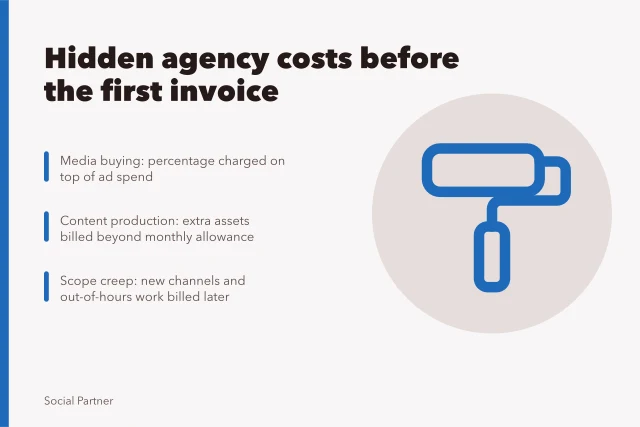
Our article on social media agencies hidden costs in England covers the charges that most often surprise buyers, including setup fees and platform access costs.
How to build a budget you can defend
Work backwards. Start with the outcome you need, then the volume of work that outcome requires, then the price of that work. Budgets built from a wish list tend to collapse at the first review.
Build a defensible budget
- Write down outcome, channels and monthly volume
- Quote fees and media spend separately
- Confirm minimum term, notice and renewal
- Get a rate card for extras
- Agree ownership of accounts and data
- Set a contingency for extras
Keep the fee budget and the media budget on separate lines. Mixing them hides how much you pay for thinking and how much you pay for reach.
The Bank of England's remit sets a 2% inflation target, and agencies tend to revisit rates when their own costs move. Expect an annual review clause in any contract longer than twelve months.
- Write down the outcome, the channels and the monthly content volume.
- Ask for fees and media spend to be quoted separately.
- Agree who owns the accounts, the creative files and the audience data.
- Set a contingency for extras rather than treating the quote as final.
Measuring payback is the other half of the argument. Our guide to social media agencies return on investment shows how to frame that case for a finance team.
Write the assumptions down. A one-page budget naming the channel count, the content volume and the media spend is far easier to defend in a review than a single number.
Checking an agency before you commit
Ask for the company number and check it. You can review an agency's registration and filed accounts through Companies House, which takes a few minutes and shows how long the business has traded.
Checks before you commit
- Ask for the company number and check it
- Review filed accounts on Companies House
- Ask who does the work day to day
- Ask how many accounts each manager holds
- Speak to a client with a similar budget
- Agree in writing who owns the accounts
Filed accounts also indicate whether a business is growing, flat or dormant. That matters before you sign a twelve-month term.
Then ask operational questions. Who does the work day to day? Is it the team in the pitch, or someone you have not met? How many accounts does each manager hold?
References beat case studies. Ask to speak to a client with a similar budget, and ask what went wrong as well as what went well.
Agree in writing who owns the accounts if the relationship ends. Losing access to a business page is a common and expensive problem.
How AI is changing the work and the price
AI tools have moved into drafting, audience research and reporting. That changes what an agency charges for, even when the monthly fee stays the same.
The American Marketing Association's analysis of marketing in the agent era describes how AI agents are reshaping marketing work. That is a useful frame when an agency explains why its scope has altered.
Data protection runs alongside that. The ICO's guidance on artificial intelligence sets out expectations for organisations using AI, and any agency automating work on your audience data should explain how it complies.
Ask two questions. Which parts of the work are automated? Who reviews the output before it publishes? Clear answers make an agency easier to hold to account.
Faster production does not automatically mean a lower fee. Some agencies pass the saving on. Others keep the fee and offer more output for it.
Our article on social media agencies trends and outlook looks at how these shifts change what agencies sell, which is worth reading before you agree a multi-year term.
Contract terms that affect the total cost
Notice periods are the most expensive clause nobody reads. Sixty days' notice on a monthly retainer means two further payments after you decide to leave.
Contract clauses that cost
Is the notice period sixty days?
Two further payments after you decide to leave
Shorter exit, lower total cost
Price review clauses set out when and how the fee can rise. A clause tied to a published inflation index is common. A clause that simply says the agency may review annually gives you less certainty.
Exclusivity costs money if you want it. Agencies sometimes limit how many clients they take in one sector, and that restriction usually appears in the fee.
Check auto-renewal. A contract that renews for twelve months unless cancelled in a narrow window can tie up a budget for longer than intended.
How to compare two quotes fairly
Compare like with like. Two quotes only line up once you have matched channels, posting frequency, content formats, community management hours and reporting.
Compare quotes like for like
Quote A
- Channels
- Match
- Posting frequency
- Match
- Content formats
- Match
- Community hours
- Match
- Reporting
- Match
- Missing line
- Video?
Quote B
- Channels
- Match
- Posting frequency
- Match
- Content formats
- Match
- Community hours
- Match
- Reporting
- Match
- Missing line
- Paid management?
If one quote is much cheaper, find out which line is missing. It is usually video, paid campaign management or out-of-hours cover.
Ask every agency to price the same brief.
Score on total cost of ownership rather than the monthly fee. Setup charges, platform access fees and early exit costs all belong in the comparison.
Where to spend more and where to save
Spend more on work that compounds. Content libraries, audience research and community management all build assets you keep.
Save on work that resets every month. Posting a daily graphic for the sake of a schedule rarely earns attention, and it consumes hours you could spend on one useful video.
Be sceptical of large reports. If nobody reads the monthly dashboard, cut it and move that budget into production.
Bulk buying can lower the unit price, but only when the brief is stable. Prepaying for twelve months of content you may not want in six months is not a saving.
How budgets grow and what a first year might cost
Costs rarely rise in a straight line. An account adding a second channel often costs less than the headline suggests, because planning and reporting are shared.
Growth in paid budgets changes the management fee more than the retainer. A percentage-based fee will climb with spend even when the creative workload stays flat.
New requirements are the usual trigger for a re-quote. Adding influencer work, a second market or a new language means new people and new approvals.
Review the arrangement each year. A scope that suited your first twelve months rarely suits the third.
An illustrative first year might combine a monthly retainer, one campaign project and a modest media budget. The split depends on scope, so treat any figure as a placeholder.
Illustrative first-year budget
- £1,500Monthly retainer
- £4,000Launch project
- £1,200Monthly media spend
- £36,400First-year total, excluding VAT
The table sets out a low, mid and high scenario using typical England rates. Fees and media spend stay on separate lines, and every figure excludes VAT.
How budgets grow
Monthly retainer
- Low
- £900
- Mid
- £1,500
- High
- £3,500
Campaign project
- Low
- £1,500
- Mid
- £4,000
- High
- £12,000
Monthly media
- Low
- £600
- Mid
- £1,200
- High
- £3,000
Year one total
- Low
- £19,500
- Mid
- £36,400
- High
- £90,000
Two things regularly break that arithmetic. Paid media usually rises once campaigns show a return. Content requirements usually grow once internal teams see what works.
Plan the second year before the first ends. Agencies often quote more keenly for a continuation than for a fresh start.
Common questions
How much should a small business budget for social media management?
There is no single rate, because the figure depends on scope. Start from the content volume you need, then ask three agencies to price the same brief. Compare totals rather than monthly headlines.
Are social media agency fees tax deductible?
For most businesses, agency fees count as a business expense when they relate to trading activity. VAT treatment depends on whether the agency is registered and whether you can reclaim it, so confirm your position with an accountant.
Is a retainer cheaper than paying per project?
Not always. Retainers usually lower the unit cost of steady work, because the agency can plan ahead. Project pricing tends to win when your needs are occasional or campaign-led.
What should I ask for in a first proposal?
Ask for a scope, a channel list, a monthly deliverable count and the minimum term. Ask for fees and media spend as separate lines. Then check the agency through Companies House before signing.
In this guide
- Social media agencies cost guide without the hidden extrasA plain-English social media agencies cost guide for England, covering retainer tiers, ad spend, VAT and a worked monthly example with labelled pound figures.
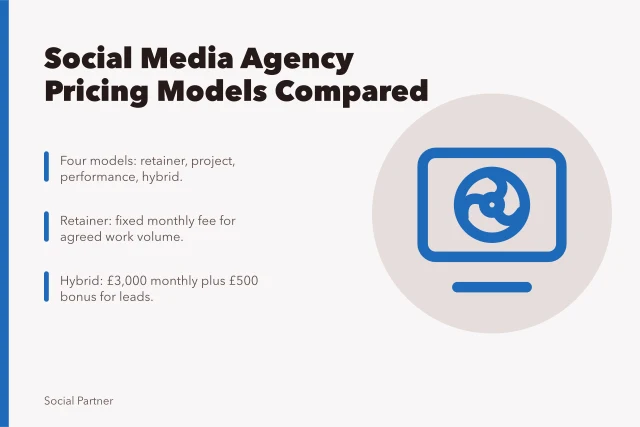
- Why social media agencies pricing models differ so muchCompare retainer, project, performance and hybrid social media agencies pricing models for England buyers, and the terms to test before signing.
- Eight lines every social media agencies budget template needsBuild a social media agencies budget template that survives finance scrutiny: eight numbered cost lines, review dates and the evidence each figure needs in England.
- How to calculate social media agency ROICalculate social media agency ROI with contribution margin, attributable revenue and a documented baseline; compare measurement approaches and review results.
- Questions to ask a social media agency before you signFive areas where a social media agency can add to the bill — media buying, content, tools, scope and exit — and the questions that cap each one.