Costs and pricing
Part of How to plan a budget for social media agencies costs and pricing
How to calculate social media agency ROI
Calculate social media agency ROI with contribution margin, attributable revenue and a documented baseline; compare measurement approaches and review results.
What to take away
Social media agency ROI is the net return from attributable activity divided by its total cost: (attributable contribution − total cost) ÷ total cost × 100. Attributable contribution is revenue linked to the agency’s work after variable costs, but before agency costs.
- Set a baseline before the agency starts, so you can separate its effect from seasonal shifts.
- Agree what counts as attributable revenue and document it in the contract.
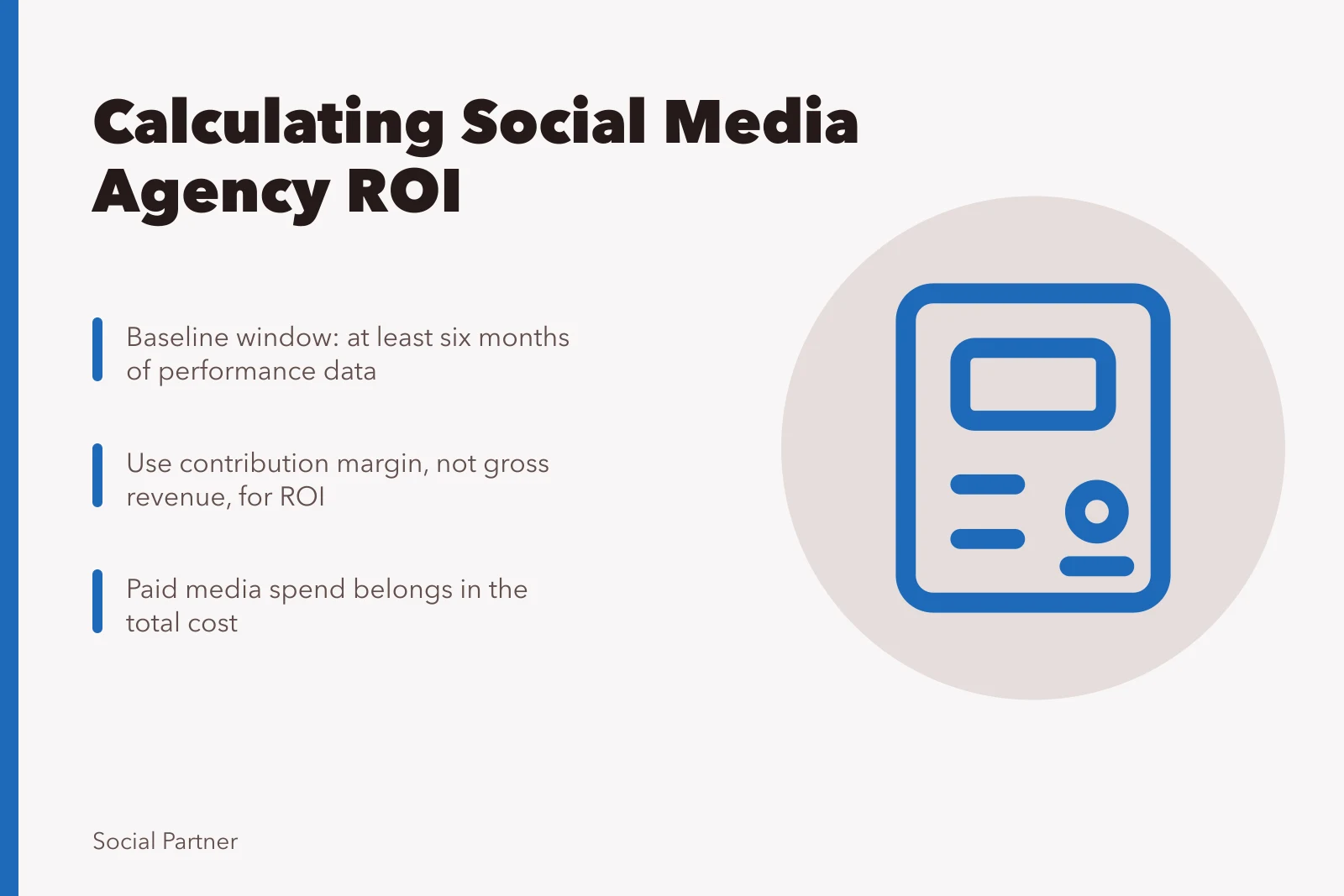
- Use contribution margin rather than gross revenue, or the figure will flatter the result.
- Model a pessimistic case as well as a central one, since agency gains build slowly.
- Review the calculation quarterly, because the first two months rarely show a stable pattern.
Build the ROI calculation step by step
Step 1: fix the baseline and the time window
Record current performance before work begins: reach, engagement, social sessions, lead volume and average order value. Use a window of at least six months, because a single month is too noisy to attribute. Without a baseline, any later claim of improvement is guesswork.
ROI calculation in four steps
- Fix baseline and six-month window
- Define attributable revenue and margin
- Total full agency cost
- Divide and sense-check ROI
Step 2: define attributable revenue and margin
Attributable revenue is the sales you can trace to social activity through tracked links, campaign codes or platform reporting. Subtract product cost, delivery and payment fees to get contribution margin.
A campaign generating £20,000 (illustrative) in sales at a 40 per cent margin contributes £8,000. For what agencies charge, read the social media agencies costs and budget guide for England.
Step 3: total the full cost of the agency
Add the retainer to management time, software licences, paid media spend and production costs. A team paying £3,500 a month (illustrative) plus £500 in internal time spends £48,000 over a year. The full figure belongs in the denominator, not just the invoice.
Step 4: divide and sense-check
ROI equals contribution profit divided by total cost, expressed as a percentage. If £60,000 (illustrative) of contribution comes from £48,000 of cost, ROI is 25 per cent. Compare that with alternative uses of the same money before you renew.
Compare the main measurement approaches
The table below sets out the common ways buyers calculate return, with the trade-offs of each.
| Measurement approach | How it measures return | Trade-off |
|---|---|---|
| Last-click attribution | Credits a conversion to the final tracked social click. | Straightforward for short consideration cycles, but does not account for earlier social interactions. |
| Incrementality testing | Compares outcomes with a control group to estimate the effect of social activity. | Helps test whether activity drove additional outcomes, but requires a feasible control group. |
| Platform reporting | Uses conversions attributed by the social platform. | Useful for reviewing platform activity, but may not capture every conversion. |
Measurement approaches compared
Last-click
- Counts
- Tracked link sales
- Strength
- Simple, auditable
- Weakness
- Misses assisted conversions
Platform reach
- Counts
- Impressions, engagement
- Strength
- Fast to compile
- Weakness
- No revenue link
Incrementality
- Counts
- With vs without
- Strength
- Closest to true effect
- Weakness
- Needs control group
Blended
- Counts
- All social-assisted sales
- Strength
- Captures wider effect
- Weakness
- Relies on assumptions
Matching the method to your objective
A lead-generation business should favour incrementality testing, because form fills are countable and a control group is feasible. A retailer with short consideration cycles can start with last-click. Whichever you choose, keep it consistent across quarters so the trend is readable.
Handling data you cannot see
Platform reporting does not capture every conversion. Where data is incomplete, state the gap rather than filling it with optimistic estimates. The Data Protection Act 2018 and UK GDPR set requirements for handling personal data gathered through tracking lawfully and transparently. The Information Commissioner's Office (ICO) is the UK's data protection regulator and also enforces the Privacy and Electronic Communications (EC Directive) Regulations 2003 (PECR), which governs the use of cookies and similar tracking technologies. Non-essential cookies generally require consent, affecting what you can record and how long you keep it.
Turn the calculation into a buying decision
Set thresholds before you brief an agency
Decide the minimum ROI that justifies the spend and write it into the brief. A business with tight margins might need 150 per cent, while a brand campaign might accept less if it also lifts branded search. Thresholds stop the calculation being reverse-engineered later.
Use the result in contract talks
Share the baseline and the agreed method with the agency from the start. If the figures miss the threshold, you have a factual basis for renegotiating scope, which is where the social media agencies pricing models in England comparison helps. For the media element, the IAB UK SME toolkit offers practical guidance on structuring digital advertising spend.
Before appointing or renewing, ask the agency to provide the baseline, attribution settings and reporting period behind its ROI claim. Request a report that explains how platform data, tracked links or campaign codes relate to your sales or lead records, along with a full cost breakdown including internal time, software, media and production. Agree access to the relevant analytics and source records, and ask the agency to flag missing data or changes in method so you can reproduce the calculation rather than rely on a headline percentage.
Improve inputs over time
Better inputs produce a better estimate. Social listening is one route: the American Marketing Association training on deriving customer insight from social data covers turning audience conversation into decisions. Track which messages drive conversion, then shift budget towards them.
Common questions
Can I calculate ROI before the agency starts?
Yes. Use your baseline and a conservative conversion assumption to produce a forecast range. Treat it as a planning estimate, not a promise, and revisit it after the first full quarter.
Should paid media spend sit in the calculation?
Yes, if the agency manages it on your behalf. Excluding it understates the cost and makes the return look stronger than it is.
How often should the figure be reviewed?
Quarterly works for most retainers. Monthly figures swing too much on small volumes, while an annual review leaves problems unaddressed for too long.
What if the result is negative in the first quarter?
That is common while campaigns bed in. Check whether the baseline was fair and whether tracking is complete before changing supplier.