Strategy
Part of Outsource your social media agencies strategy or keep it in house?
Build a social media agencies planning template that survives scrutiny
Planning template for social media agencies in England: objectives, budget lines, compliance checks and review dates so scope is agreed with clients early.
What to take away
- A planning template is a decision toolit forces you to choose objectives, budget and sign-off before work starts.
- Run it on three columnsactivity, owner and evidence. If an activity has no evidence line, cut it.
- Compliance belongs on page one. UK data protection law and the CAP Code shape what an agency can publish.
- Build the template around a review date, so the plan is tested against results rather than renewed by habit.
Set the planning template's spine
Decide what the template is for before you write a line. A pitch version needs a budget and an outcome. An internal version needs owners and deadlines.
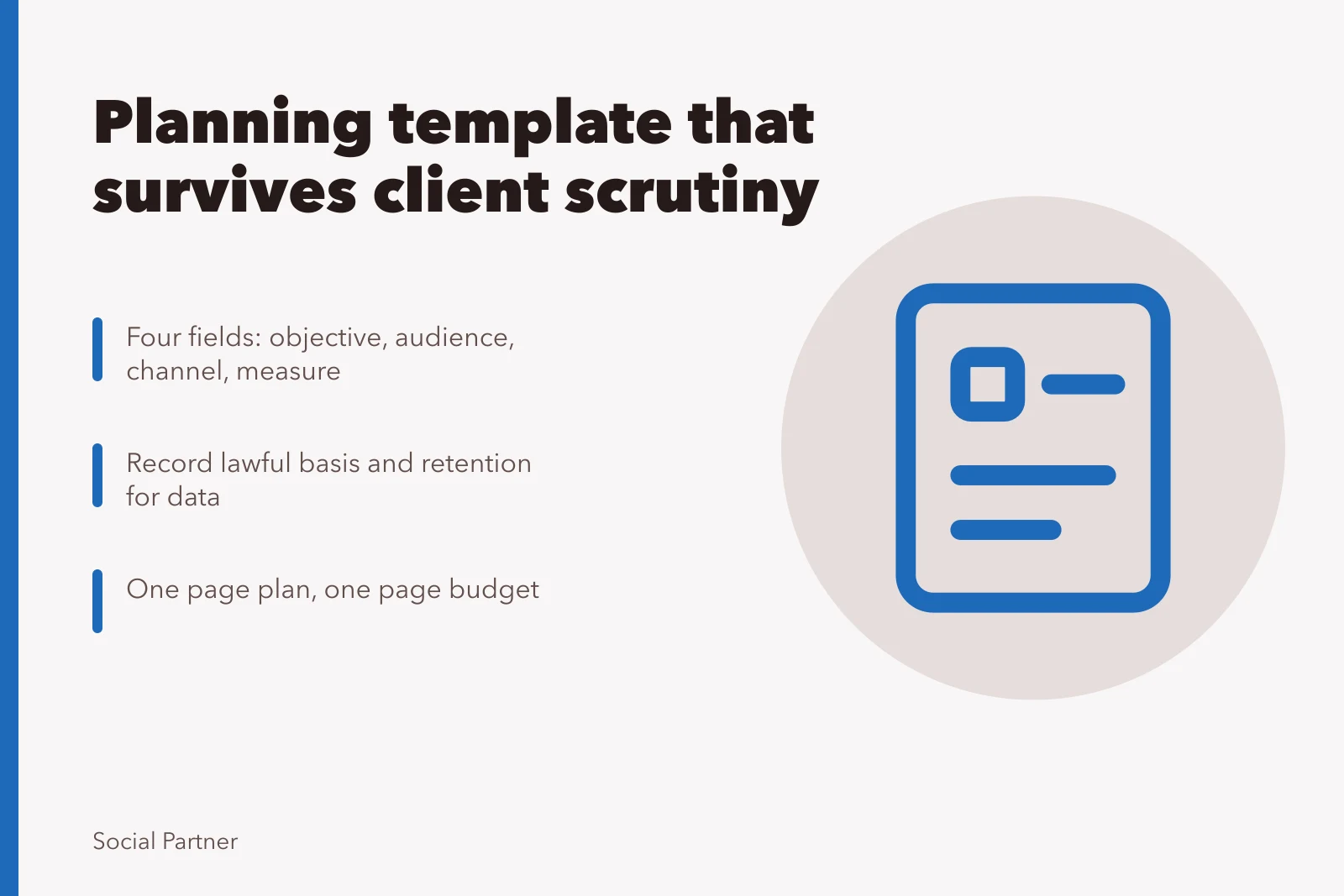
Four planning template fields
- Objectivewhat change is intended
- Audiencewho it is for
- Channelwhere it runs
- Measurehow success is judged
A template that tries to do both does neither. Agencies managing several clients keep a master template for structure and a client sheet for numbers.
Start with four fields: objective, audience, channel and measure. Anything that cannot be tied to one of these is a nice idea, not a plan. The strategy and planning guide sets out the wider sequence.
Use this one-page skeleton, in this order:
| Order | Field | Entry |
|---|---|---|
| 1 | Objective | Observable change, maximum three per quarter |
| 2 | Audience | Named group and platform |
| 3 | Channel and format | Platform, organic or paid, ad format |
| 4 | Budget line | Media, production, management, contingency |
| 5 | Measure | Metric, baseline, target, date |
| 6 | Evidence line | What you will look at and when |
| 7 | Lawful basis and retention | Why data is held and deletion date |
| 8 | Client sign-off | Name, role, date approved |
| 9 | Review date | Date and owner |
Client sign-off is recorded in row 8, with the name, role and date approved.
Objectives that survive a quarterly review
Write each objective as a change you can observe. "Grow engagement" is not observable. "Increase saves on recipe posts by 20% between October and December" is. A team paying £400 a month should be able to say what that money is meant to change.
Limit the plan to three objectives per quarter. More than three and the review becomes a reading exercise. Each objective needs one owner, one measure and one date.
Worked objective row, all figures illustrative. The objective reads: Increase saves on recipe posts by 20% between 1 October and 31 December. Owner: content lead. Measure: Instagram saves. Baseline: 400 saves in the previous quarter. Target: 480 saves. Evidence: monthly Instagram insights export. Client sign-off: [client name], [role], [date].
Budget lines and what belongs in them
Separate media spend from production and from management fees. Mixing them hides the true cost of social media management and makes renewals harder to justify.
Add a contingency line of 10% for platform changes and boosted posts. Label it clearly so it is not spent by accident. List client-paid tools separately.
Worked budget row, all figures illustrative. Media: Instagram single image ads, £600 per month. Production: four short videos, £400 one-off. Management fee: £250 per month. Contingency: 10% of media, £60 per month. Client sign-off: [client name], [role], [date].
Add compliance and evidence to the template
Compliance sits inside the plan as a set of checks, not a separate document. The Data Protection Act 2018 governs how personal data from social platforms is processed, including audience lists and lead forms.
Add a column for lawful basis and retention. If the plan involves uploading a customer list, the template should record why that data is held and when it is deleted.
For example, an illustrative cell might read: Lawful basis: consent for email marketing, recorded on the sign-up date. Retention: delete 24 months after last engagement. Check the period against the client's privacy notice.
For paid posts, the CAP Code sets the rules on recognition, substantiation and targeting. Put a check box next to every ad concept. Ticking a box at planning stage is quicker than pulling a campaign later.
Platform plans and B2B choices
If the client sells to other businesses, LinkedIn often carries the paid budget. The official LinkedIn marketing solutions pages describe the ad formats and targeting available, which helps when you write the platform line.
Name the formats you intend to use. "LinkedIn ads" is too vague for a budget line. "Single image ads to HR job titles, £600 per month" is a plan.
Evidence and review triggers
Pick measures that match the objective, not the ones that are easiest to screenshot.
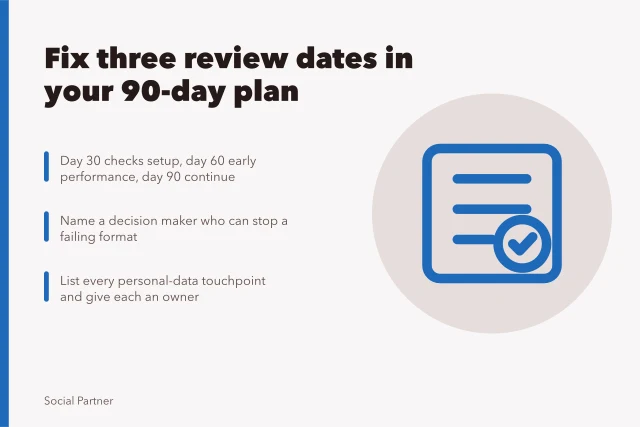
Set a review date before the plan starts. A 90-day cycle works for many accounts, and the ninety day plan shows how to break the quarter into fortnightly checkpoints.
Common questions
How long should a planning template be?
One page for the plan and one page for the budget is enough for most accounts. Longer templates rarely get read after the kick-off meeting.
Who owns the template?
The agency usually owns the structure and the client owns the numbers. Agree this at the start so neither side edits the other's fields without a conversation.
What should be in the glossary?
Include terms the client will hear: reach, impressions, saves, cost per result, and boosted post. Define them once so review meetings stay short.
- Reachthe number of accounts that saw a post.
- Impressionsthe number of times a post was displayed.
- Savesthe number of users who stored a post for later.
- Cost per resultmedia spend divided by the chosen outcome.
- Boosted postan organic post given paid distribution.