

Rules and ethics
IR35 and HMRC off-payroll rules for UK social media agencies hiring freelancers
Social media management agencies hiring freelancers must apply IR35 off-payroll rules, issue status determination statements and price retainers for compliance.
What to take away
- Social media management agencies that engage freelance social media managers must apply HMRC off-payroll working rules when the freelancer works through their own limited company.
- The agency is usually the client for IR35, not the end brand, so it must issue a status determination statement before the engagement starts.
- CEST guidance from HMRC supports a determination, but it is not binding and agencies should keep evidence of actual working practices.
- Retainer pricing implications include higher day rates for inside-IR35 contracts, employer National Insurance and possible VAT treatment changes.
- Contracts, insurance and evidence should be reviewed before the first invoice, not after an HMRC compliance check begins.
How HMRC off-payroll working rules reach social media management
HMRC off-payroll working rules, commonly called IR35, apply when a worker provides services through an intermediary such as a personal service company. The rules ask whether the worker would have been an employee of the client if engaged directly. If the answer is yes, the fee payer must deduct income tax and National Insurance.
When off-payroll rules applied
- April 2021Rules reached the private sector
- Since 2021Medium and large clients determine status
- Small clientsExempt; contractor's company decides
- NowAgencies hiring freelancers must assess control
The rules reached the private sector in April 2021. Since then, medium and large private-sector clients have been responsible for determining status. Small clients are exempt, and the contractor's own company remains responsible. For social media management, this matters because agencies often hire freelance social media managers for content calendars, paid campaigns and community management.
A social media manager on a retainer may look self-employed on paper. HMRC looks at control, substitution and mutuality of obligation. If the agency controls when and how the work is done, and the freelancer cannot send a substitute, the engagement may fall inside IR35.
You can review the latest Employment in the UK - Office for National Statistics data when forecasting freelance capacity.
The ONS publishes Business activity, size and location data that helps directors benchmark how many similar firms engage freelancers.
Social media management is project-based but often continuous. A monthly retainer with set hours, weekly calls and agency-approved tools can look like employment. A project with a defined deliverable and the freelancer's own equipment looks more like a business-to-business contract.
The first step for any agency is to map every freelance engagement. List the worker, their intermediary, the end client and who pays the fee. That map determines who must operate PAYE and who carries the risk.
Who counts as the client for IR35 in an agency engagement
The client is the party that receives the services and has the right to control the work. In most agency engagements, the agency is the client because the agency directs the freelancer and owns the client relationship. The end brand may be the beneficiary, but it is not automatically the client for IR35.
Small company exemption tests
- £10.2mMaximum annual turnover
- £5.1mMaximum balance sheet total
- 50Maximum employees
- 2 of 3Tests needed to qualify as small
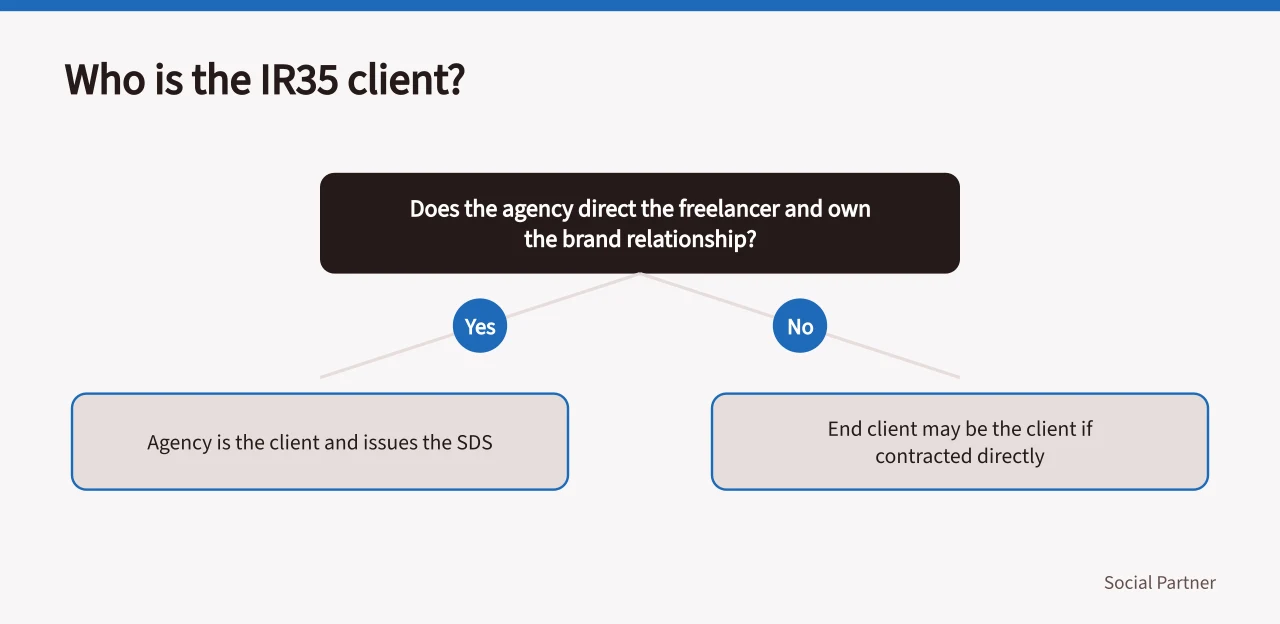
This distinction is important. If the agency is the client, the agency must make the status determination, issue the status determination statement and operate PAYE if the engagement is inside IR35. The end client may also be a client if it contracts directly with the freelancer, but that is less common in social media management.
Where an agency supplies a freelancer to an end client, the agency may be both the client and the fee payer. The fee payer is the party that pays the worker's intermediary. In a chain, the fee payer is usually the agency closest to the freelancer.
Small companies are exempt from the off-payroll rules. A small company is one that meets two or more of these tests: annual turnover not more than £10.2 million, balance sheet total not more than £5.1 million, and not more than 50 employees. If the agency is small, the freelancer's own company decides status and pays the correct tax.
End clients can be small too. If the end client is small, the rules do not apply to that engagement, even if the agency is large. That is why agencies should check the end client's size before making a determination.
Companies House is the first place to check. You can verify a company's filing history, accounts and confirmation statements through Companies House - GOV.UK. This helps confirm whether an end client is small or part of a larger group.
Agency directors should also consider their own structure. If the agency is part of a group, the group's size may determine whether the agency is small. Accountants often apply the rules at the group level, so a small subsidiary of a large group may still be inside the rules.
For social media management, the client question often turns on who sets the content strategy. If the agency sets the strategy and the freelancer executes it, the agency is the client. If the end brand sets the strategy and the agency only introduces the freelancer, the end brand may be the client.
Get this wrong and the agency can be liable for unpaid tax, interest and penalties. HMRC can also transfer liability down the chain if the client fails to issue a status determination statement.
Status determination statements and CEST in practice
A status determination statement, often called an SDS, is a written statement that gives the client's determination and the reasons for it. It must be given to the worker and to any party in the chain that the client contracts with. The statement must be issued before the engagement starts or before the next payment.
Building an SDS with CEST
- Gather contract, statement of work and emails
- Complete CEST using actual working practices
- Review result against contract and reality
- Write the SDS with determination and reasons
- Issue SDS to worker and chain parties
The SDS must state whether the engagement is inside or outside IR35. It must also explain the reasons. A bare conclusion is not enough. HMRC expects the client to show that it has taken reasonable care.
CEST guidance from HMRC is a free online tool that helps clients assess employment status. CEST stands for Check Employment Status for Tax. It asks about control, substitution, financial risk and the working arrangements. The result can support an SDS, but it is not legally binding.
CEST has limits. It does not cover every scenario, and it can give an inside or outside result that HMRC later disputes. Agencies should use CEST as one input, not as the only evidence. Keep a record of the answers and the result.
Here is a practical sequence for social media management engagements:
- Gather the contract, the statement of work and any emails that describe how the freelancer will work.
- Complete CEST with the actual working practices, not the ideal ones.
- Review the result against the contract and the day-to-day reality.
- Write the SDS with the determination and the reasons.
- Give the SDS to the freelancer and to any agency in the chain that you contract with.
- Keep a copy and a record of the date it was issued.
A worked example shows how this can look. An agency in Manchester hires a freelance social media manager on a six-month retainer for 20 hours a week. The freelancer works from the agency office two days a week, uses agency software and cannot send a substitute.
The agency sets the posting schedule and approves every post. CEST returns an inside-IR35 result. The agency issues an SDS with that determination and operates PAYE on the fee.
If the same freelancer works from home, sets their own hours, uses their own tools and can send a substitute, CEST may return an outside result. The agency still issues an SDS, but the fee payer does not deduct PAYE. The freelancer's company pays its own tax.
Agencies should review SDSs when the engagement changes. A new scope, a longer term or more control can move an engagement inside IR35. The client must issue a new SDS if the determination changes.
Disagreements happen. The worker or the fee payer can challenge the SDS through the client's disagreement process. The client must respond within 45 days. If the client does not respond, it becomes the fee payer and carries the liability.
For social media management, the most common flashpoints are control over content and exclusivity. A freelancer who works only for the agency, on agency hours, with agency approval, looks like an employee. A freelancer with multiple clients and their own process looks more like a business.
The team roles explained article is useful when deciding which tasks need a freelancer and which need an employee. That decision affects both IR35 risk and the agency's cost base.
Pricing freelance social media management retainers after IR35
Retainer pricing implications change when an engagement is inside IR35. The fee payer must deduct income tax and employee National Insurance from the deemed employment payment. The fee payer also pays employer National Insurance. That increases the real cost of the engagement.
Inside vs outside IR35 retainer
Inside IR35
- Payment route
- Deemed employment payment
- PAYE deducted
- Yes, by fee payer
- Employer NI
- Paid by fee payer
- Net pay
- Needs gross-up
- Real cost
- Higher retainer
Outside IR35
- Payment route
- Company invoice
- PAYE deducted
- No
- Employer NI
- Not applicable
- Net pay
- As invoiced
- Real cost
- Lower retainer
Outside IR35, the agency pays the freelancer's company invoice. The freelancer's company handles its own tax. The agency does not deduct PAYE, but it may still need to consider VAT and the apprenticeship levy if the payment is deemed employment.
A common approach is to agree a gross fee and then adjust for the inside-IR35 cost. If the freelancer wants the same net pay, the agency must gross up the fee. That gross-up can add a significant percentage to the monthly retainer.
Here is an illustrative monthly gross-up for 2025/26. Assume the freelancer wants £3,000 net. The agency must cover PAYE income tax at 20% and employee National Insurance at 8% on earnings above the monthly primary threshold of £1,047.50. That produces a gross deemed payment of about £3,759.
Employer National Insurance at 15% applies above the monthly secondary threshold of £416.67, adding about £501. Employer pension contributions of at least 3% of qualifying earnings would add about £97. The total agency cost is about £4,358, a gross-up of about 45% over the £3,000 net.
Agency retainer pricing also depends on the scope. A social media manager who creates content, schedules posts and reports on performance may command a higher rate than a scheduler. The cost guide without the hidden extras helps agencies compare direct costs with the true cost of compliance.
Freelance social media manager rates vary by region. London and the South East tend to be higher than the North East and Wales. Scotland and the North West sit in the middle. Agencies should benchmark rates against the local market, not a national average.
Typical advertised day rates in England are about £150 to £250 in the North East, Wales and the Midlands. Rates are about £200 to £300 in the North West and Scotland, and £250 to £450 in London and the South East.
These bands are indicative, not official statistics, and seniority, sector and retainer length move the figure.
When pricing, separate the freelancer fee from the compliance cost. Build a line for employer National Insurance and pension auto-enrolment if the engagement is inside IR35. If the freelancer is outside IR35, keep evidence of the determination and avoid day-rate creep that looks like employment.
Inside IR35, employer National Insurance and the gross-up come out of the same client fee, so the agency's margin on a retainer narrows unless the contract allows a rate review, as the pricing models differ article explains. A project fee with a clear deliverable may be easier to defend than an open-ended monthly retainer.
VAT treatment can change too. If the fee payer operates PAYE, the payment may be outside the scope of VAT for the deemed employment part. The agency should take advice from an accountant on the VAT position.
Here is a simple checklist for pricing a new freelance social media management retainer:
- Confirm the freelancer's intermediary and company status.
- Check whether the agency and end client are small or large.
- Complete CEST and keep the result.
- Issue the SDS before the first payment.
- Calculate the gross-up for employer National Insurance.
- Agree who bears the cost of a status change.
- Review the rate every six months.
Agencies that ignore these steps can face unexpected costs. HMRC can recover unpaid tax from the fee payer, plus interest and penalties. The cost of a compliance failure is usually higher than the cost of getting the determination right.
The ONS publishes UK business: activity, size and location - Office for National Statistics data for SIC 73.1 advertising and agency firms.
Contracts, insurance and evidence agencies should keep
The contract is the first piece of evidence. It should describe the services, the deliverables, the fee and the working arrangements. It should also include a substitution clause, a right not to offer work and a right not to accept it.
Evidence file to keep
- Contract with genuine substitution clause
- Professional indemnity and public liability cover
- Timesheets, invoices, emails and briefs
- Performance reports showing actual working
- SDS, CEST answers and disagreement record
A substitution clause must be genuine. If the agency can veto a substitute, the clause is weak. The freelancer should be able to send a suitably qualified replacement without unreasonable refusal.
Insurance matters too. Agencies should check that the freelancer has professional indemnity insurance and public liability cover. If the engagement is inside IR35, the agency may need employer's liability insurance for the deemed employee.
Evidence should cover the whole engagement. Keep timesheets, invoices, emails, briefs and performance reports. These show how the work was actually done, which is what HMRC examines.
Agencies should also keep a record of the SDS, the CEST answers and any disagreement process. If HMRC opens a compliance check, this file is the first thing it will ask for.
Contracts should include an IR35 clause. The clause should set out who makes the determination and what happens if the status changes. It should also allow the agency to recover costs if HMRC issues a demand.
Here are four clauses to include, with example wording:
Contracts, insurance and evidence
- SubstitutionThe freelancer may send a suitably qualified substitute to perform the services, subject only to the agency's reasonable approval of that substitute's qualifications and security clearance.
- No mutualityThe agency is not obliged to offer work and the freelancer is not obliged to accept any offer. Each assignment is a separate contract.
- Determination ownershipThe agency will issue a status determination statement before each engagement and will review it if the working practices change.
- Cost recoveryIf HMRC issues a demand to the agency for tax, interest or penalties arising from this engagement, the freelancer will reimburse the agency for that demand within 30 days of written notice.
For social media management, the scope of work should be specific. A vague brief that says the freelancer will manage all social media can look like an ongoing role. A defined project with clear outputs is easier to defend.
Agencies should also consider the skills, check the oversight gaps before hiring. If the agency lacks in-house oversight, it may be tempted to give the freelancer more control, which increases IR35 risk.
Record keeping is not just about tax. It also supports good client service. When a client asks who created a post or approved a campaign, the agency can show the trail.
Companies House filings can change. A freelancer's company may be dissolved or become dormant. Agencies should recheck company status at least annually and before renewing a retainer.
If the freelancer uses an umbrella company, the agency should check who operates PAYE. Umbrella companies can add complexity, and the agency may still be the fee payer. Get written confirmation of the payroll arrangement.
Common IR35 mistakes UK agencies make with freelancers
One common mistake is assuming that a limited company contractor is automatically outside IR35. The intermediary does not decide status. The working practices do.
Seven IR35 mistakes to avoid
- Assuming limited company means outside IR35
- Using CEST once and never reviewing
- Failing to issue an SDS
- Treating the end client as the client
- Ignoring the small company exemption
- Letting freelancers set rates without gross-up
- Poor record keeping of working practices
Another mistake is using CEST once and never reviewing it. Engagements change, and so does status. A determination from last year may not fit this year's scope.
A third mistake is failing to issue an SDS. The client must issue a statement, even if the determination is outside IR35. Without it, the client can become the fee payer and carry the liability.
A fourth mistake is treating the end client as the client. In most agency engagements, the agency is the client. Getting this wrong means the wrong party makes the determination.
A fifth mistake is ignoring the small company exemption. If the agency is small, the rules do not apply to its engagements. But size is measured at group level, so a small agency in a large group may still be inside the rules.
A sixth mistake is letting the freelancer set their own rate without considering the gross-up for inside IR35. That can leave the agency with an unexpected employer National Insurance bill.
A seventh mistake is poor record keeping. Without evidence of working practices, the agency cannot show that it took reasonable care.
HMRC penalties for careless errors can reach 30% of the potential lost revenue, rising to 70% for deliberate errors and 100% for deliberate and concealed errors.
Late payment interest runs at the Bank of England base rate plus 3.25 percentage points, and late payment penalties add 5% at 30 days, another 5% at six months and another 5% at 12 months.
Agencies should also avoid blanket bans on limited company contractors. A blanket ban can breach the off-payroll rules and may be challenged. The correct approach is to determine status for each engagement.
Training helps. Finance managers and account handlers should know the signs of an inside-IR35 engagement. They should also know when to escalate to an accountant or legal adviser.
Finally, agencies should review their insurance and contracts together. A contract that says one thing and a working practice that says another is a red flag. The evidence should match the contract.