Tools and providers
Part of Social media agency for ecommerce UK: what to ask before hiring
Social media agency for ecommerce UK: what to ask before hiring
Choosing a social media agency for ecommerce in the UK: platform mix, UK GDPR duties, TikTok Shop scope and the questions to ask before you sign a retainer.
What to take away
- A generalist social media agency rarely covers what an online shop needs, because organic content, paid social, TikTok Shop and marketplace listings each reward different work.
- Ask how the agency handles UK GDPR when it runs giveaways, builds email lists or uploads customer data for audience matching.
- Product claims and discounts sit under the CAP Code, so request examples of ads the agency has written and amended.
- Retainers for ecommerce carry heavier creative production than service-business accounts. Price the filming and editing separately from posting.
Why an ecommerce brief differs from a brand brief
Retail social is judged on sales rather than reach. An agency that has only run awareness campaigns for service businesses will need to learn your margins, returns rate and stock cycle before it can plan anything useful.
Platform mix should be settled early. A Shopify store, a TikTok Shop and an Amazon listing each reward different edits of the same idea, and a single clip rarely travels across all three without changes.
Ownership matters too: catalogue images, customer clips and paid ad variants should transfer to you on payment, and the contract needs to say so in plain words. Write the same asset list into the agency brief, so the scope and the ownership clause cannot drift apart.
Rules your agency has to work inside
UK GDPR applies the moment you collect an email address, run a giveaway or upload a customer list for audience matching. The ICO's guide to UK GDPR sets out the lawful bases and what you must tell people.
Advertising claims sit under the CAP Code, which the ASA enforces. Discounts must be genuine, previous prices must have been charged, and stock statements must be accurate. The advertising codes are the reference point when an agency drafts a sale post for you.
The Consumer Rights Act 2015 runs alongside both, and the CMA enforces it. Cooling-off rights, refunds and delivery promises apply to online orders, and copywriters who ignore them create complaints you have to answer.
Matching channels to what the agency should run
No single plan fits every shop, so ask the agency to map its scope against the platforms you sell on.
Channel scope and evidence
Channel
- TikTok Shop
- affiliate, samples, live
- Amazon
- A+ content, brand store
- Your own store
- landing pages match creative
- Paid social
- audience, creative, pacing
Scope to agree
- TikTok Shop
- seller performance data
- Amazon
- listings for category
- Your own store
- test plan for variants
- Paid social
- monthly spend report
Evidence to request
- TikTok Shop
- Amazon
- Your own store
- Paid social
TikTok Shop mixes content with marketplace mechanics, so the seller tools matter as much as the video. TikTok for Business documents both, and it is fair to ask which of those tools an agency has used.
A five-step vetting sequence
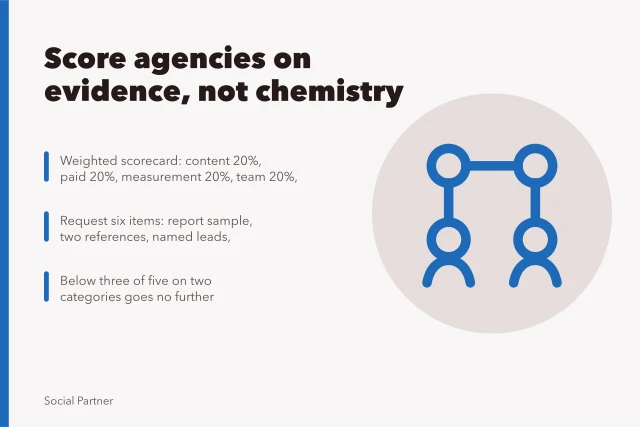
- Ask for two ecommerce accounts the agency has run for at least six months, and buy from both shops yourself.
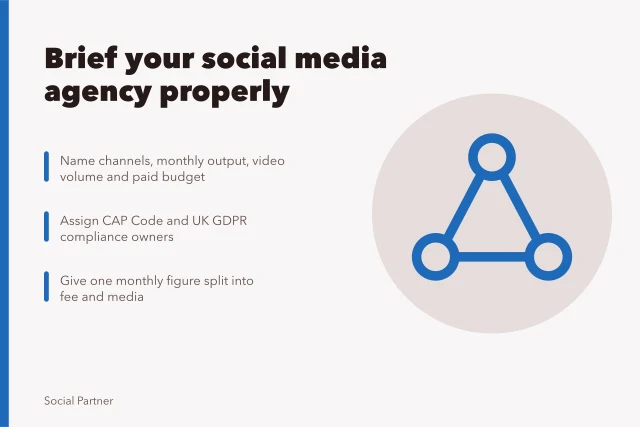
- Request a written scope naming each channel, the number of posts and videos a month, and who films and edits.
- Ask how performance is reportedrevenue, return on ad spend or reach. Insist on seeing the dashboard before you sign.
- Check the data terms. Who is the controller, where is customer data stored, and what happens to it when the contract ends?
- Agree a notice period and a handover clause that covers ad accounts, pixels and creative files.
Ask which dashboard you will be shown, channel by channel: Google Analytics 4 or Shopify reports for the shop, Meta Ads Manager or TikTok Ads Manager for paid social, and the seller tools behind TikTok Shop. Shortlist two or three agencies from our social media agency directory before you send the brief, and make each one answer the same list.
How the retainer should be built
Ecommerce work carries more production than a service account, because creative goes stale quickly. A monthly fee buys the team, while ad spend, affiliate commissions and marketplace fees sit outside it.
Ask for the quote in three parts: the fee for the team's time, the ad spend you pay the platforms yourself, and any commission or marketplace fees. A retainer is only comparable once the scope behind it is written down, because a heavier scope costs more.
If your shop runs seasonal peaks, compare a fixed project fee with a rolling retainer on the same scope. The retainer versus project decision should be made in writing, not in a pitch.
Treat any quote that bundles filming, paid media and marketplace management into one line with caution. Ask for the split, then compare it against what you would pay a freelancer for the same output.
Common questions
Do I need an ecommerce specialist rather than a general agency?
Not always, but the brief has to be retail-specific. A generalist can learn the category if it has run paid social with product feeds before, so test that with a short paid pilot first.
What should a TikTok Shop agency handle?
Shop setup, affiliate and creator programmes, live selling and the content that feeds them. Ask which of those it does in-house and which it outsources, because the answer changes the fee.
How do I check an agency's data protection record?
Ask for the controller and processor roles in writing, plus where customer data is hosted. The ICO's guidance is the standard to test their answers against, and a vague reply is a warning sign.
Ask whether the agency is a controller or a processor for each list it touches. Where it acts as a controller — for its own giveaways or newsletters, say — it must pay the ICO's data protection fee under the Data Protection (Charges and Information) Regulations 2018 and appears on the ICO's public register of fee payers, which you can check yourself.
Is social media management enough for a Shopify store?
Only if the shop already converts traffic well. If your landing pages, delivery times or product images lose sales, more posting will not fix that.